 Color Swatch Lab
Open data · version 1.0
Open paint guidance data
6 small tables (54 rows) of original paint guidance from our guides, free to download and reuse with credit under CC BY 4.0.
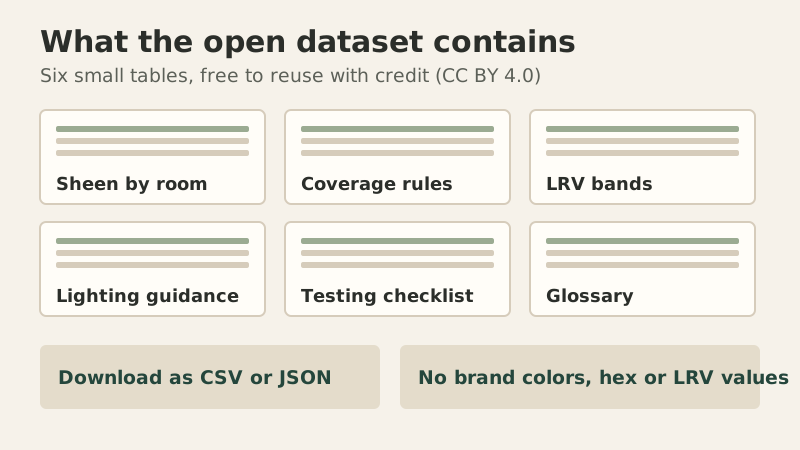
What this is not: it contains no brand color names, hex values or LRVs. Brand color data is not licensed for republication, so we do not publish it here.
Downloads
- Common sheen by room or surface (CSV)
- Paint coverage rules of thumb (CSV)
- LRV bands by general shade category (CSV)
- Lighting guidance for testing paint (CSV)
- Sample-testing checklist (CSV)
- Glossary of paint terms (CSV)
- All tables (JSON)
How to cite
Preferred citation
Color Swatch Lab Editorial Team (2026). Color Swatch Lab open paint guidance dataset (version 1.0). Color Swatch Lab. https://colorswatchlab.com/data/. Licensed under CC BY 4.0.
Last updated . Please link to https://colorswatchlab.com/data/.
License
Our original compilation, wording and structure are licensed under Creative Commons Attribution 4.0 (CC BY 4.0). Credit "Color Swatch Lab Editorial Team" and link back. The license covers our own work only. Pages and standards we cite remain the property of their owners; each row links to them so you can check the original.
Methodology note
- What goes in: structured facts and rules of thumb already published in our guides. Each row is either compiled from the cited public sources (URL shown in the Source column, space-separated when several apply) or labeled Color Swatch Lab editorial guidance when it is our own rule of thumb.
- What stays out: any brand's color names, hex or RGB values, or LRVs, and any measured color data. Our own measurements are still being planned; see the methodology.
- Sources agree broadly, not row by row. Where several sources are listed they broadly agree; individual sources may differ in detail (see the guide linked under each table).
- Rules of thumb are not standards. LRV bands, door and window allowances and similar numbers are editorial guidance. Use your product's own data sheet for coverage and your own light for color decisions.
- Versioning: version 1.0, first published October 25, 2026. Updates change the last-updated date above.
- Corrections: see our editorial policy.
Common sheen by room or surface
Commonly recommended paint sheen for each room or surface type, with the reason. Guidance, not a rule: check each product’s washability claims. Related guide · CSV
Paint coverage rules of thumb
Rules of thumb for estimating how much paint a room needs. Always use the coverage printed on your product’s can or technical data sheet. Related guide · CSV
| Rule | Value | Notes | Source |
|---|---|---|---|
| Wall area | perimeter × wall height | Example: a 12 × 12 ft room with 8 ft walls is 384 sq ft | How to Use Paint Calculator, FAQs (Sherwin-Williams); How Much Paint Do I Need? (This Old House) |
| Door allowance | about 20 sq ft per door | Subtract from wall area | Color Swatch Lab editorial guidance |
| Window allowance | about 10–15 sq ft per window | Subtract from wall area | Color Swatch Lab editorial guidance |
| Number of coats | 2 typical | Multiply paintable area by coats | Color Swatch Lab editorial guidance |
| Coverage per gallon, paint (smooth, primed surface) | about 350–400 sq ft | Lower on textured, porous or unprimed surfaces | PPG Ultra-Hide Zero Interior technical data sheet (PPG, PDF); How to Use Paint Calculator, FAQs (Sherwin-Williams) |
| Coverage per gallon, primer | about 200–300 sq ft | Check the primer’s own data sheet | Color Swatch Lab editorial guidance |
| Accent wall or door | about 1 quart (roughly 100 sq ft) | Rough amount for small jobs; check the can | Color Swatch Lab editorial guidance |
| Ceiling area | length × width ÷ coverage, per coat | Ceilings are usually painted with flat white | Color Swatch Lab editorial guidance |
| Worked example result | 2 gallons | (384 − 20 − 30) × 2 coats ÷ 350 sq ft per gallon ≈ 1.9 | Color Swatch Lab editorial guidance |
| Homes built before 1978 | read lead-paint guidance first | Before sanding or scraping old paint | Reduce the Risk of Lead Exposure at Home (US EPA); Lead Renovation, Repair and Painting Program (US EPA) |
LRV bands by general shade category
Generic rule-of-thumb bands of light reflectance value (0 to 100) for broad shade categories. These are our editorial bands, not an industry standard, and contain no brand or color-specific values. Related guide · CSV
| LRV min | LRV max | Shade category | Typical use | Source |
|---|---|---|---|---|
| 70 | 100 | Whites and off-whites | Ceilings, trim, dim rooms | Color Swatch Lab editorial guidance |
| 50 | 70 | Light to mid neutrals | Whole-house walls | Color Swatch Lab editorial guidance |
| 30 | 50 | Mid-tones | Bright rooms, accent walls, cabinetry | Color Swatch Lab editorial guidance |
| 10 | 30 | Dark | Moody rooms, doors, exteriors | Color Swatch Lab editorial guidance |
| 0 | 10 | Near black | Doors, dramatic accents | Color Swatch Lab editorial guidance |
| 30 | 30 | Accessibility contrast (difference, not a band) | BS 8300:2018 treats contrast as adequate when two surfaces’ LRVs differ by at least 30 points | Light reflectance value (Wikipedia) |
Lighting guidance for testing paint
Light-bulb color temperature (kelvin) and CRI guidance for judging paint samples. Related guide · CSV
| Topic | Guidance | Value | Source |
|---|---|---|---|
| Warm white bulbs | Yellowish, “warm white” light | about 2700–3000 K | Color temperature (Wikipedia) |
| Cooler bulbs | Whiter, bluer light; the same paint reads cooler | 4000 K and above | Color temperature (Wikipedia); Learn About LED Lighting (ENERGY STAR) |
| Color rendering index (CRI) | Maximum score is 100; higher shows paint closer to how it looks in good daylight | 90+ is a common target for testing | Color Swatch Lab editorial guidance |
| Consistency | Use the same bulb color temperature throughout a space | one temperature per space | Color Swatch Lab editorial guidance |
| Test at night | Check samples under your own lamps as well as in daylight | day and night | Color Swatch Lab editorial guidance |
| Window direction (Northern Hemisphere) | North light is cooler and even; south light is warmer and stronger | swap in the Southern Hemisphere | Color Swatch Lab editorial guidance |
| Metamerism | Two colors can match under one light and differ under another | test under actual bulbs | Metamerism (color) (Wikipedia) |
Sample-testing checklist
An ordered checklist for testing paint samples before buying gallons. Related guide · CSV
| Step | Action | Why | Source |
|---|---|---|---|
| 1 | Go big: use samples about paper-sized or larger | Tiny swatches are hard to judge | Color Swatch Lab editorial guidance |
| 2 | Isolate from the old color (white board or peel-and-stick) | Surrounding colors change what you see | Chromatic adaptation (Wikipedia) |
| 3 | Test on several walls: window wall, side wall, shadowed corner | Light differs by wall | Color Swatch Lab editorial guidance |
| 4 | Check at three times of day, including night under your lamps | Light changes through the day | Color temperature (Wikipedia) |
| 5 | Keep fixed elements in view: floors, counters, trim, fabric | Colors are judged in context | Color Swatch Lab editorial guidance |
| 6 | Compare side by side, then alone | Side by side reveals undertone; alone shows mood | Color Swatch Lab editorial guidance |
| 7 | Wait two to three days | First impressions shift | Color Swatch Lab editorial guidance |
| 8 | Record the winner: brand, name, code and sheen | So the match can be repeated | Color Swatch Lab editorial guidance |
Glossary of paint terms
Plain-language definitions written by the Color Swatch Lab editorial team. Related guide · CSV
| Term | Definition | Source |
|---|---|---|
| LRV (light reflectance value) | The share of visible light a surface reflects, on a scale from 0 (absorbs all) to 100 (reflects all). Real paints never reach the ends. | Light reflectance value (Wikipedia) |
| Undertone | The subtle hue that shows through a color, especially a neutral, and makes it lean warm or cool. | Color wheel (Wikipedia) |
| Warm and cool colors | Warm colors lean yellow, red or orange; cool colors lean blue, green or violet. | Color wheel (Wikipedia) |
| Sheen (finish) | How much light a dried paint reflects directly, from flat to high-gloss. More sheen is easier to wash and shows more flaws. | Gloss (optics) (Wikipedia); How to Choose Paint Finishes (Sherwin-Williams) |
| Flat | The lowest sheen. Diffuses light, hides flaws, least washable. | How to Choose Paint Finishes (Sherwin-Williams) |
| Matte | Slightly more sheen than flat, with a soft look; some modern mattes are washable. | How to Choose Paint Finishes (Sherwin-Williams) |
| Eggshell | A low sheen with a faint glow, common for living areas. | How to Choose Paint Finishes (Sherwin-Williams) |
| Satin | A medium sheen that is smooth and washable, common for kitchens, baths and trim. | How to Choose Paint Finishes (Sherwin-Williams) |
| Semi-gloss | A shiny, durable sheen common for trim, doors and cabinets. | How to Choose Paint Finishes (Sherwin-Williams) |
| High-gloss | The shiniest sheen; very durable and very revealing of surface flaws. | How to Choose Paint Finishes (Sherwin-Williams) |
| Color temperature (kelvin) | A number describing whether white light looks warm (low) or cool (high). | Color temperature (Wikipedia) |
| CRI (color rendering index) | A 0 to 100 score for how faithfully a light source shows object colors. | Color rendering index (Wikipedia) |
| Metamerism | Two colors that match under one light but differ under another. | Metamerism (color) (Wikipedia) |
| Chromatic adaptation | The visual system’s adjustment to the prevailing light color, which changes how colors are perceived. | Chromatic adaptation (Wikipedia) |
| Color drenching | Painting walls, trim and often the ceiling in the same color for a seamless look. | Color Swatch Lab editorial guidance |
| Peel-and-stick sample | A sheet painted with real paint that you stick on the wall and move around. | Color Swatch Lab editorial guidance |
| Coverage | How many square feet a gallon of paint covers per coat, as stated on the can or data sheet. | PPG Ultra-Hide Zero Interior technical data sheet (PPG, PDF) |
Questions about the data or want to tell us how you used it? Email [email protected].