 Color Swatch Lab
Guides · CSL–018
Paint flashing and lap marks
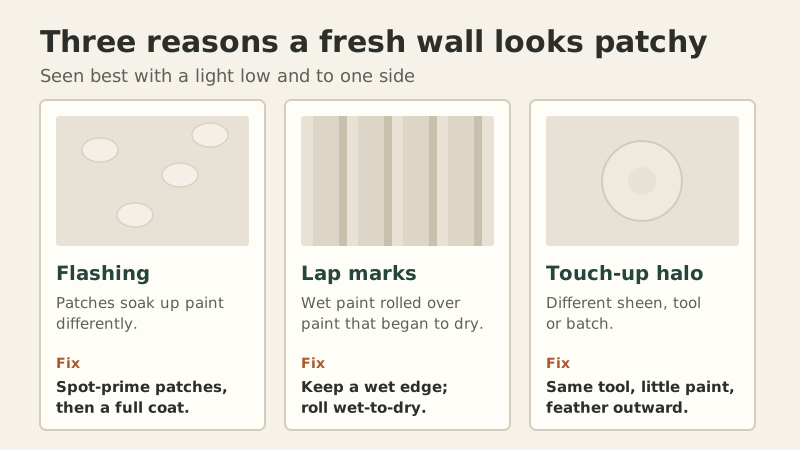
Which problem do you have?
| What you see | Name | Usual causes |
|---|---|---|
| Dull or shiny spots that line up with filled nail holes, patches or bare drywall | Flashing | Porous spots soak up paint differently; paint applied unevenly or too thin; moisture or temperature swings while drying |
| Stripes or bands of deeper color or extra gloss, often roller-width | Lap marks | Rolling wet paint over paint that had started to dry; sun, wind or a porous surface making paint dry too fast; uneven film thickness |
| A halo around a touch-up spot | Touch-up flashing | Different sheen, texture, applicator or batch from the original coat |
Look at the wall with a light low and to one side (raking light). Sheen differences jump out in raking light even when the color matches.
Fixing flashing
- Let the paint dry fully, then check again in raking light.
- Spot-prime patched areas so their porosity matches the rest of the wall. Prime any bare surface before the topcoat.
- Apply another full coat, corner to corner. Sherwin-Williams notes that an additional coat often evens out sheen irregularities.
- Use the film thickness and applicator the data sheet recommends. Paint spread too thin is a listed cause.
Preventing lap marks
- Keep a wet edge. Roll from the unpainted area back into the wet paint ("wet to dry"), not the other way round.
- Work in manageable sections and plan stops at natural breaks: corners, doors and windows.
- Cut in at those planned breaks with a brush while the wall paint is still wet.
- Avoid fast-drying conditions: direct sun, wind and hot surfaces. Seal very porous surfaces with primer first.
- Load enough paint and keep the same pressure and pace.
Touch-ups that disappear
Benjamin Moore's touch-up advice comes down to matching three things: color, sheen and surface texture. Use the same kind of roller or brush as the original job, paint in the same direction, and start with very little paint, working from the center out and feathering the edges. Flat and matte finishes touch up most easily; the glossier the finish, the harder it gets. Sherwin-Williams adds that using the same application method and batch helps. If a touch-up still shows, repaint the whole wall corner to corner. For small applicators and storing leftovers, see paint storage and touch-up supplies.
Choosing a sheen with touch-ups in mind: paint sheen guide. Timing your second coat: dry time vs cure time.
FAQ
- Will paint flashing go away when it dries?
- Judge it only once the paint is fully dry. If spots still show, spot-prime the patched areas and apply another full coat; Sherwin-Williams notes an additional coat often evens out sheen differences.
- Why do my touch-ups show?
- Touch-ups show when the sheen, texture, applicator or batch differs from the original paint. Glossier finishes show them most. Use the same tool and very little paint, feather the edges, or repaint the whole wall.
- How do I avoid lap marks with a roller?
- Keep a wet edge: roll from dry areas back into wet paint, work one wall at a time in manageable sections, stop only at corners or openings, and avoid painting in direct sun or wind.
- Does primer prevent flashing?
- Priming bare surfaces and spot-priming patches evens out how porous the wall is, which removes one of the main causes of flashing.
- Which sheen hides flashing best?
- Flatter finishes. Manufacturers note that flat and matte finishes touch up more easily than glossy ones, which show every difference in sheen.
Sources
- Uneven Gloss (Flashing) (Sherwin-Williams)
- How to Prevent Paint Lap Marks (Benjamin Moore)
- How to Touch Up Paint (Benjamin Moore)
- Emerald Interior Latex Matte K36 product data sheet (Sherwin-Williams, PDF)
Sources checked October 26, 2026. Rules of thumb on this page are our editorial guidance, not standards.