 Color Swatch Lab
Guides · CSL–015
Paint dry time vs cure time
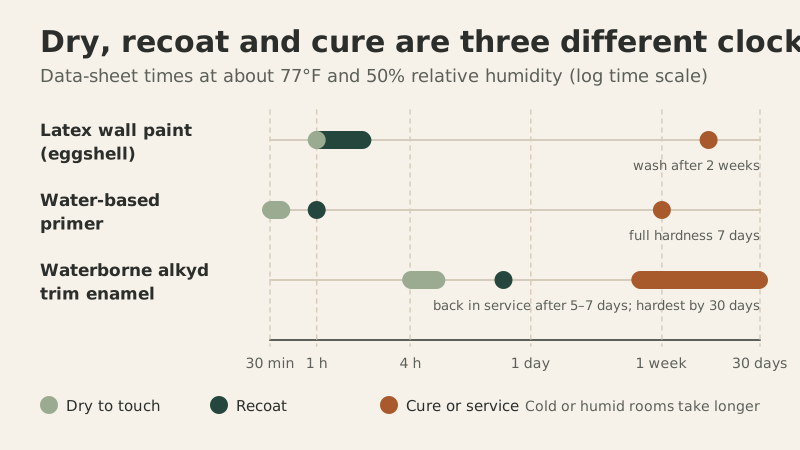
Three clocks, three different questions
| Milestone | What it means | What it controls |
|---|---|---|
| Dry to touch | The surface no longer feels wet or transfers to a light touch. The film underneath is still soft. | When dust stops sticking and you can safely walk past |
| Recoat | The earliest time the next coat can go on without disturbing the one below | Your second coat, and when you can start cutting in again |
| Cure (service) | The film has developed its hardness and adhesion | Washing, scrubbing, putting objects on shelves, heavy use of doors and cabinets |
The mistake most people make is treating "dry to touch" as "done." A wall that feels dry after an hour can still be soft enough to scuff, stick to objects pressed against it, or lift if you scrub it.
What real data sheets say
We read the technical data sheets for five widely sold products, one per common paint type. Every time below is the manufacturer's figure at its standard test condition, about 77°F (25°C) and 50% relative humidity (Zinsser lists 70–80°F).
| Paint type (example data sheet) | To touch | To recoat | Cure or service note |
|---|---|---|---|
| Interior acrylic latex, eggshell (Benjamin Moore Regal Select) | 1 hour | 1–2 hours | Can be washed after two weeks |
| Interior latex, matte (Sherwin-Williams Emerald) | 1 hour | 4 hours | No cure time listed; times depend on temperature, humidity and film thickness |
| Zero-VOC interior latex (PPG Ultra-Hide Zero) | 1 hour | 4 hours | No cure time listed |
| Water-based primer (Zinsser Bulls Eye 1-2-3) | About 30–35 minutes | Topcoat after 1 hour | Full adhesion and hardness in 7 days |
| Waterborne alkyd enamel for trim and cabinets (Benjamin Moore Advance) | 4–6 hours | 16 hours | No heavy abrasion or shelves back in service for 5–7 days; up to 30 days to reach optimum hardness and final sheen |
Products are examples of each paint type, not recommendations. Your can's label or data sheet always wins.
Why your paint is taking longer
- Humidity and cold. Benjamin Moore's sheets say high humidity and cool temperatures lengthen dry, recoat and cure times; Sherwin-Williams says its times depend on temperature, humidity and film thickness.
- Too cold to paint at all. Several of these latex paints list 50°F as the minimum application temperature. The Zinsser primer allows 35–90°F but also caps relative humidity at 85%.
- Thick coats. A heavy coat holds more water or solvent, so it dries slower than the data sheet assumes. Two normal coats beat one thick one.
- Enamels are slower. Alkyd-type trim and cabinet enamels level out into a smoother, harder finish, but the trade-off is long recoat and cure times.
A practical timeline for one room
- Between coats: wait for the recoat time on your can, not just touch-dry. Rolling over a coat that is still soft can drag it and leave marks (see flashing and lap marks).
- Tape: pull painter's tape at a shallow angle once the final coat is dry to the touch or slightly before. If you must tape over fresh paint for a stripe or two-tone wall, use a delicate-surface tape and check its label for how new a painted surface it can go on.
- Furniture and art: keep anything from pressing against fresh paint for at least a day. Shelves and cabinet doors painted with an enamel need longer; the Advance sheet says 5–7 days before shelves go back into service.
- Cleaning: avoid scrubbing for the first couple of weeks. Benjamin Moore's eggshell sheet says its walls can be washed after two weeks.
- Cabinets and trim: treat them gently for the first month if you used an enamel; full hardness can take that long.
Planning the job? Work out quantities first with how much paint you need, and pick the finish with the sheen-by-room chart. Ventilate while paint dries; see low-VOC paint explained.
FAQ
- How long should paint dry between coats?
- Use the recoat time on the can or data sheet, not the touch-dry time. For the interior latex wall paints we checked it was 1 to 4 hours at 77°F and 50% humidity; a waterborne alkyd trim enamel needed 16 hours. Allow longer in cool or humid rooms.
- How long does paint take to fully cure?
- It depends on the product. One water-based primer reaches full adhesion and hardness in 7 days, one waterborne alkyd enamel says it can take up to 30 days to reach optimum hardness, and one latex wall paint says walls can be washed after two weeks.
- Does humidity slow paint drying?
- Yes. Manufacturers state that high humidity and cool temperatures lengthen dry, recoat and cure times, and some primers should not be applied above 85% relative humidity.
- When can I put furniture back against a freshly painted wall?
- Wait at least a day so nothing sticks to or marks the soft film, and longer for painted shelves and cabinet doors. One enamel data sheet asks for 5–7 days before shelves go back into service.
- What is the minimum temperature for painting?
- Check the label. Several interior latex paints list 50°F as the minimum air and surface temperature, while some primers allow application down to 35°F.
Sources
- Regal Select Interior Eggshell 549 technical data sheet (Benjamin Moore, PDF)
- Emerald Interior Latex Matte K36 product data sheet (Sherwin-Williams, PDF)
- PPG Ultra-Hide Zero Interior technical data sheet (PPG, PDF)
- Bulls Eye 1-2-3 Water-Based Primer technical data BEY123-01 (Zinsser / Rust-Oleum, PDF)
- Advance Waterborne Interior Alkyd Satin 792 technical data sheet (Benjamin Moore, PDF)
Sources checked October 26, 2026. Rules of thumb on this page are our editorial guidance, not standards.