 Color Swatch Lab
Guides · CSL–017
Low-VOC and zero-VOC paint explained
What VOCs are, and why paint has them
The EPA describes volatile organic compounds as gases given off by certain solids and liquids, some with short- and long-term health effects. Paints contain organic solvents, and products like these release VOCs while you use them and, to some degree, while they are stored. The EPA also notes that indoor levels of many VOCs are consistently higher than outdoor levels, and that elevated levels can linger after an activity ends.
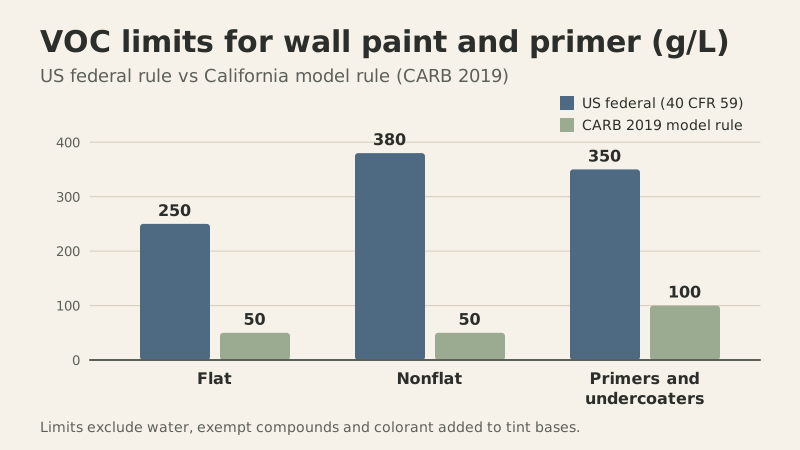
The legal limits for wall paint
| Category | US federal limit (40 CFR 59, Subpart D) | California model rule (CARB 2019 SCM) |
|---|---|---|
| Flat coatings | 250 g/L | 50 g/L |
| Nonflat coatings (eggshell to gloss) | 380 g/L | 50 g/L (100 g/L before January 1, 2022) |
| Primers, sealers and undercoaters | 350 g/L | 100 g/L |
Both rules measure VOC per liter of coating excluding water and exempt compounds, and both exclude colorant added to tint bases. CARB's measure is a model rule: California air districts adopt it into their own rules, so check your local district for exact limits. Under the CARB rule, "flat" means a gloss below 15 on an 85-degree meter or below 5 on a 60-degree meter. Anything glossier is "nonflat."
How to read a data sheet
Look for "VOC" on the product's technical data sheet. Here is what five common products list:
- PPG Ultra-Hide Zero interior latex: 0 g/L, with a note that colorants added to the base may raise VOC significantly depending on the color.
- Benjamin Moore Regal Select eggshell: less than 50 g/L.
- Sherwin-Williams Emerald interior matte: less than 50 g/L, stated "as per 40 CFR 59.406."
- Benjamin Moore Advance waterborne alkyd enamel: 48.5 g/L.
- Zinsser Bulls Eye 1-2-3 water-based primer: less than 100 g/L.
Why "zero-VOC" is not the whole story
- Tint adds VOC. The regulated number excludes colorant, and manufacturers warn that colorant can raise it. Deep colors take the most colorant. CARB's 2019 measure caps colorant added at the point of sale, such as a paint store's tinting machine, at 50 g/L from 2022 in districts that adopt it.
- Content is not emissions. The g/L figure describes what is in the can. Some products also carry a separate indoor-emissions certification; Benjamin Moore's Advance sheet, for example, lists "CDPH Emissions Certified."
- Solvent-based specialty products are different. Oil-based primers and stain blockers can be much higher. Use the respirator their label calls for (see our safety gear guide).
Practical steps
- For bedrooms, nurseries and rooms you will use right away, compare VOC on the data sheets and pick a low number.
- Ventilate while painting and drying. The EPA advises increasing ventilation when using products that emit VOCs and following label precautions.
- Buy only what you need (how much paint), and close and store leftovers properly. The EPA notes products can keep releasing VOCs in storage.
- Plan for drying time before you move back in: dry time vs cure time.
FAQ
- What counts as low-VOC paint?
- Brands use the term differently, so check the number. A practical benchmark is California's model limit of 50 g/L for flat and non-flat paint; many interior paints list less than 50 g/L on their data sheets.
- Is zero-VOC paint really zero?
- The untinted base may list 0 g/L, but colorant added at the store can raise the VOC level. PPG notes this on its zero-VOC data sheet. Deep colors take the most colorant.
- Do I still need to ventilate with low-VOC paint?
- Yes. The EPA advises increasing ventilation whenever you use products that emit VOCs, and following the label's precautions.
- Where do I find a paint's VOC content?
- On the label or the technical data sheet, in grams per liter (sometimes also pounds per gallon). Search the product name plus "technical data sheet" on the manufacturer's site.
- Why are primers allowed more VOC than paint?
- Both the federal rule and California's model rule give primers, sealers and undercoaters their own, higher limit: 350 g/L federally and 100 g/L under the CARB model rule.
Sources
- Volatile Organic Compounds' Impact on Indoor Air Quality (US EPA)
- 40 CFR Part 59 Subpart D: VOC emission standards for architectural coatings, Table 1 (eCFR)
- 2019 Suggested Control Measure for Architectural Coatings (California Air Resources Board, PDF)
- PPG Ultra-Hide Zero Interior technical data sheet (PPG, PDF)
- Regal Select Interior Eggshell 549 technical data sheet (Benjamin Moore, PDF)
- Emerald Interior Latex Matte K36 product data sheet (Sherwin-Williams, PDF)
- Advance Waterborne Interior Alkyd Satin 792 technical data sheet (Benjamin Moore, PDF)
- Bulls Eye 1-2-3 Water-Based Primer technical data BEY123-01 (Zinsser / Rust-Oleum, PDF)
Sources checked October 26, 2026. Rules of thumb on this page are our editorial guidance, not standards.