 Color Swatch Lab
Guides · CSL–016
Why is my paint peeling?
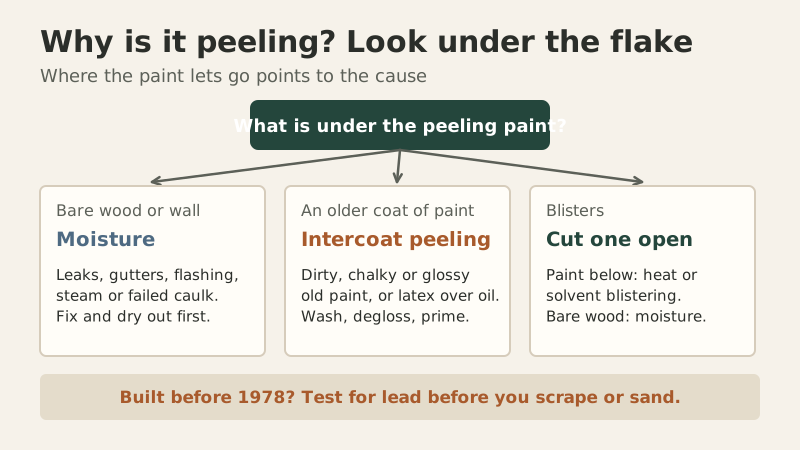
Read the failure first
Where the paint lets go tells you why. Look at what is left under a flake: bare wood or wall, or another layer of paint.
| What you see | Likely cause |
|---|---|
| Peeling down to bare wood, worst at board ends, joints, below gutters and roof valleys | Moisture behind the paint: rain, leaks or water vapor moving out through the wall |
| The newest coat lifting off the old one (intercoat peeling), often on porch ceilings and under eaves | The old surface was not cleaned well enough before repainting; dirt and salts build up where rain never rinses |
| A latex topcoat peeling off old oil-based paint | Incompatible coatings: latex cannot grip hard, glossy or chalky oil paint without the right primer |
| Small blisters in the top coat within a day or two of painting in hot sun, with paint under them | Temperature (solvent) blistering: the surface skinned over and trapped vapor |
| Blisters with bare wood under them | Moisture blistering |
| Fine cracks or a reptile-skin pattern in thick old paint | Too many layers: the film became brittle (crazing, then alligatoring) |
Common indoor causes
- Bathrooms and laundry rooms: steam is moisture. Run an exhaust fan that vents outdoors, fix any leaks, and let the wall dry before repainting.
- Glossy trim and doors: paint applied over gloss enamel without sanding or a bonding primer has little to grip. Data sheets tell you to sand glossy surfaces first.
- Kitchens: grease is a release agent. Data sheets require a clean, dry surface free of grease before painting.
- New plaster or masonry: painted too soon, it can push paint off. Benjamin Moore and PPG data sheets ask for a 30-day cure before painting new plaster.
The tape test before you repaint
Purdue Extension suggests a simple adhesion check: clean the old surface, paint a small patch, let it dry for at least two days, then press an adhesive bandage onto it and snap it off. If paint comes away on the tape, the old surface is too chalky or dirty. Clean it again or use an oil-based primer.
How to repair peeling paint
- Check for lead first. The EPA says homes built before 1978 are more likely to have lead-based paint, and peeling or chipping paint there is a lead-dust risk. Test before you disturb it, and use lead-safe practices or a certified contractor.
- Fix the moisture source. Faulty flashing, leaking gutters, bad shingles, cracked caulk and shrubs touching the siding all feed peeling. The National Park Service puts it bluntly: repainting before you deal with moisture is pointless, because the new paint will fail too.
- Let it dry out thoroughly.
- Scrape to a sound edge and feather the edges with sandpaper. Sherwin-Williams suggests testing the paint 6 to 12 inches around each peeled spot to make sure it is still firmly attached.
- Wash. Scrub with detergent and water, rinse, and pay extra attention to protected areas like porch ceilings and eaves.
- Prime bare spots. The National Park Service recommends priming bare wood within 48 hours, and an oil-type primer where latex is going over old oil paint.
- Repaint in normal coats. Purdue notes that a total film of about 4 to 6 mils (primer plus top coats) gives the longest service life, and that building up too many layers leads to cracking.
Repainting the patches? Allow full recoat times (dry time vs cure time), and spot-prime repairs so they do not show through the new paint (flashing and lap marks). Choose washable sheens for damp rooms: sheen by room.
FAQ
- Can I paint over peeling paint?
- Not directly. New paint bonds to the loose layer and peels with it. Scrape back to firmly attached paint, sand the edges smooth, clean, prime any bare areas, then repaint, after fixing whatever caused the peeling.
- Why is the paint peeling in my bathroom?
- Usually moisture from showers, sometimes combined with paint applied over a dirty or glossy surface. Fix leaks, run an exhaust fan vented outdoors, let the wall dry, then prep and repaint.
- Why is new paint peeling off the old paint?
- That is intercoat peeling. It usually means the old surface was dirty, chalky or glossy, or the coatings were incompatible. Purdue Extension notes it usually shows up within a year of repainting.
- Is peeling paint dangerous?
- In homes built before 1978 it can be. The EPA warns that peeling or chipping lead-based paint creates dust and chips that are a hazard, especially for young children. Test before scraping or sanding.
- Can I put latex paint over oil-based paint?
- Yes, with preparation: clean it, sand or degloss it, and apply a primer made for the job. The National Park Service recommends an oil-type primer, which can take either an oil or latex topcoat.
Sources
- Preservation Brief 10: Exterior Paint Problems on Historic Woodwork (National Park Service, PDF)
- Paint Failure Problems and Their Cure, NCR-133 (Purdue University Cooperative Extension)
- Intercoat Peeling in Protected Areas (Sherwin-Williams)
- Reduce the Risk of Lead Exposure at Home (US EPA)
- PPG Ultra-Hide Zero Interior technical data sheet (PPG, PDF)
- Advance Waterborne Interior Alkyd Satin 792 technical data sheet (Benjamin Moore, PDF)
Sources checked October 26, 2026. Rules of thumb on this page are our editorial guidance, not standards.