 Color Swatch Lab
Guides · CSL–020
When is it too cold, hot or humid to paint outside?
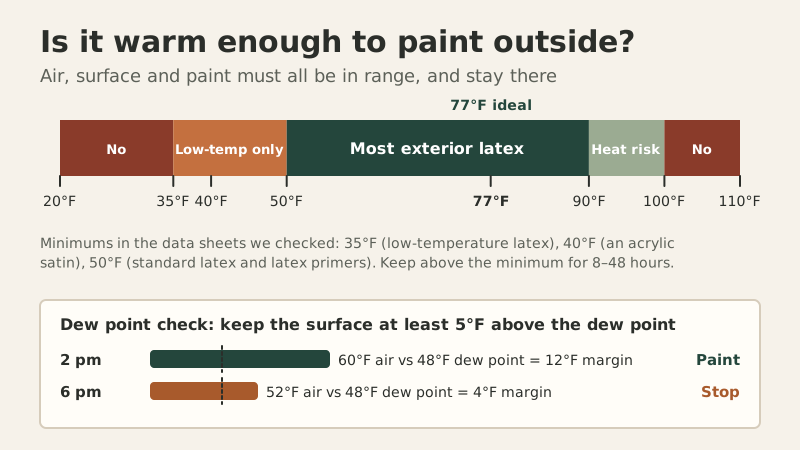
The go/no-go checklist
| Check | Rule | What the sources say |
|---|---|---|
| Air and surface temperature | At or above the product's minimum | 35°F for Sherwin-Williams A-100 and some Diamond Vogel low-temperature paints; 40°F for Benjamin Moore Ultra Spec EXT; 50°F for standard exterior latex (Diamond Vogel) and for standard latex primers (Sherwin-Williams). |
| Temperature after painting | Must not drop below the minimum while the paint forms its film | 48 hours above 35°F (A-100); 24 hours above 35°F (Diamond Vogel low-temperature paints); 8 hours above 50°F (Diamond Vogel standard latex). |
| Dew point | At least 5°F of margin above the dew point | Benjamin Moore calls it the industry standard for the surface temperature. Sherwin-Williams applies it to the air, surface and paint. |
| Rain | None forecast before the paint can take it | A-100: avoid if rain or snow is expected within 2–3 hours. Diamond Vogel: no rain forecast within 8 hours. |
| Heat and sun | Surface not above the product's maximum; avoid stacking fast-drying conditions | Ultra Spec EXT lists a 100°F maximum surface temperature. Diamond Vogel warns against combining more than two or three of: above 95°F, direct bright sun (especially dark colors), a hot surface, a hot and porous surface, wind, and humidity under 20%. |
| The paint itself | Warmed to its range before use | Benjamin Moore: a can left in an unheated garage stays cold; bring it inside overnight. |
Why cold weather causes failures
Latex paint dries by water evaporating, then the resin particles fuse into a film. Too cold, and that fusing is incomplete. Diamond Vogel lists weaker adhesion, toughness and longevity, plus poor gloss, color problems and cracking. Benjamin Moore lists extended dry times, peeling and latex that fails to form a film at all.
Cold also slows everything down. The A-100 data sheet gives a recoat time of 4 hours above 45°F but 24–48 hours between 35 and 45°F. Sherwin-Williams also warns that when the air is 35°F, surfaces may be colder, so measure the wall, not just the air.
Why heat and sun cause failures too
Paint that dries too fast cannot level or form a proper film. Benjamin Moore lists poor flow and leveling, wrinkling, blistering and peeling. It also notes that a dark wall in direct sun can be much hotter than the air, and suggests checking with an infrared thermometer. A practical habit: follow the shade around the house. Paint west-facing walls in the morning and east-facing walls in the afternoon, after the sun has moved off them.
The dew point rule in practice
Dew point is the temperature at which moisture condenses out of the air. Most weather apps show it. Compare it with the coldest temperature the wall will reach before the paint is dry.
- Example: at 2 pm the air is 60°F and the dew point is 48°F, a 12°F margin, so you can paint. By 6 pm the forecast is 52°F with the same dew point, which leaves only 4°F, and shaded siding may already be cooler than the air. Stop early enough for the last coat to dry before evening.
- In spring and fall, finish by mid-afternoon. Dew forms quickly as temperatures fall at the end of the day.
- If moisture is visible on the surface or on nearby surfaces, do not paint. Diamond Vogel also says to skip days at 90% humidity or above when the temperature is expected to drop.
If rain hits fresh paint
Benjamin Moore's advice: stop painting, and leave any bubbles alone. They may go down as the water evaporates. If they are still there after a day or two, scrape, sand, clean and repaint those areas. Washed-off or streaked areas need recoating once the surface is dry.
Dark colors on vinyl siding
Heat matters for color choice too. Sherwin-Williams' A-100 sheet says not to paint vinyl darker than its original color or with a color whose LRV is below 56. Benjamin Moore's Ultra Spec EXT sheet uses 57, unless the color is on its approved vinyl palette. Darker colors absorb more heat and can warp the siding. See what LRV means.
Exterior peeling usually starts with moisture: why paint peels. Recoat and cure basics: dry time vs cure time.
FAQ
- What is the lowest temperature you can paint outside?
- It depends on the product. Some exterior latex paints are rated down to 35°F and others to 40°F, while standard exterior latex and many latex primers need at least 50°F. The minimum applies to the air, the surface and the paint, and has to hold for several hours or days after painting.
- Can I paint outside if it will freeze tonight?
- Usually not. The data sheets we checked require temperatures to stay above the minimum for 8 to 48 hours after application, depending on the product. A frost tonight means paint today is at risk.
- How long does exterior paint need before rain?
- Check the label. One exterior latex says to avoid painting if rain or snow is expected within 2–3 hours; one manufacturer's general guidance is no rain within 8 hours.
- What is the dew point rule for painting?
- Keep at least 5°F between the surface temperature and the dew point while the paint dries, so moisture does not condense on the wet film. Benjamin Moore describes this as the industry standard.
- Is it OK to paint in direct sun?
- It is best avoided. Sun can heat a wall well above the air temperature, especially a dark one, so the paint dries before it levels and forms a film. Manufacturers list wrinkling, blistering and peeling as results. Follow the shade around the house.
Sources
- A-100 Exterior Latex Flat A06-Series product data sheet (Sherwin-Williams)
- Application Conditions for Exterior Latex Paint, technical bulletin (Diamond Vogel, PDF)
- Temperature Guide for Exterior Painting (Benjamin Moore)
- Ultra Spec EXT Exterior Acrylic Satin W448 technical data sheet (Benjamin Moore, PDF)
Sources checked October 27, 2026. Rules of thumb on this page are our editorial guidance, not standards.