 Color Swatch Lab
Guides · CSL–021
How to dispose of leftover paint
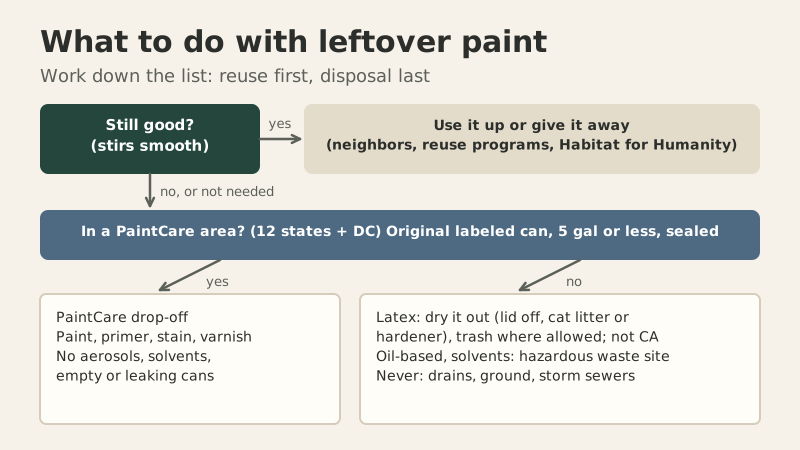
The order to work through
- Use it up. PaintCare suggests using a gallon or more as primer on another project, less than a gallon for a small room or accent wall, and a quart for a window frame or the inside of a bookshelf.
- Give it away. Neighbors, community groups and artists can use good paint. Some PaintCare partners run reuse programs, and New Hampshire's environmental agency suggests donating full or mostly full cans to Habitat for Humanity.
- Recycle it through PaintCare if you live in a program state.
- Dispose of it the way your local program requires.
What PaintCare takes, and what it does not
| Accepted at PaintCare sites | Not accepted |
|---|---|
| Interior and exterior house paint (latex, acrylic, water-based, alkyd, oil-based, enamel, including textured coatings); deck and floor paints; primers, sealers and undercoaters; stains; shellac, lacquer, varnish and single-component urethane; waterproofing sealers (not tar-based); metal coatings and rust preventatives | Thinners, mineral spirits and other solvents; aerosol spray paint; auto, marine, art and craft paints; caulk, epoxy, glue and adhesives; colorants and additives; wood preservatives with pesticides; roof patch, asphalt and tar products; two-component coatings; empty, leaking or unlabeled containers |
Containers must be the original can, no larger than 5 gallons, with the manufacturer's printed label and a secure lid. PaintCare's FAQ also says not to mix paints together. The program is only for residents and businesses in that state, and DC sites check proof of residency. PaintCare says about 80% of what it collects is latex, most of which goes into recycled-content paint, while oil-based products are mostly used as fuel.
Outside PaintCare states: what goes where
| What you have | Typical route |
|---|---|
| Latex (water-based) paint, a thin layer left | Take the lid off and let it dry, then put it in the trash, where local rules allow. |
| Latex paint, about a quarter can | Stir in a drying agent such as cat litter, cardboard scraps or sawdust, or a commercial paint hardener. Iowa's DNR says hardener leaves a tacky, oatmeal-like mix that will not spill. |
| Latex paint, half a can or more | Layer the paint with a drying agent in a cardboard box until it is dry (New Hampshire DES), or donate it if it is still good. |
| Oil-based, alkyd or solvent-based paint, stain or varnish | Household hazardous waste collection. New Hampshire does not recommend air-drying it. |
| Aerosol spray paint | Not accepted by PaintCare. New Hampshire treats it as universal waste for transfer stations or hazardous waste events. Check locally. |
| Thinners and solvents | Household hazardous waste collection |
| Paint already dried rock-hard | Trash with the lid off so collectors can see it is solid, except in California, where PaintCare says dried paint may not go in the trash. |
| Empty cans | PaintCare does not take them. Recycle them curbside where accepted, otherwise put them in the trash, truly empty and with the lid off. |
Latex or oil? "Enamel" can be either. Check the cleanup line on the label: soap and water means water-based; mineral spirits means solvent-based.
What never to do
The EPA lists pouring household hazardous products down the drain, on the ground or into storm sewers, and in some cases putting them in the regular trash, as improper disposal. Liquid paint in the trash can spill on collectors and trucks, which is why local programs insist it be dried first.
Keeping paint worth keeping
- Seal it well. PaintCare suggests a paint key, not a screwdriver, to open the can, a clean rim, plastic wrap over the opening and a rubber mallet to close the lid. It says flipping the can upside down is not necessary if the lid is tight. Iowa's DNR, by contrast, suggests storing cans upside down, so do whichever you prefer, but check the seal first.
- Keep it from freezing and dry. According to PaintCare, paint that has frozen once or twice is still good if it stirs smooth; if it stays lumpy, it is spoiled. Damp storage rusts cans and loosens labels.
- Label it with the color, sheen, room and date, and paint a stripe on the outside to show the level.
Buying less in the first place is easiest: how much paint you need. For storage and touch-up supplies, see paint storage and touch-up supplies. For what the VOC number on the can means, see low-VOC paint explained.
FAQ
- Can I throw paint in the trash?
- Liquid paint, no. Many local programs accept latex paint in the trash once it is completely dried or hardened, with the lid off. Oil-based paint usually has to go to household hazardous waste collection. In California, PaintCare says even dried paint may not go in the trash.
- How do I dry out latex paint quickly?
- For a small amount, leave the can open in a ventilated spot. For more, stir in cat litter, sawdust, shredded paper or a commercial paint hardener until it will not spill, or layer it with a drying agent in a cardboard box.
- Where can I recycle paint for free?
- In PaintCare areas (12 states and the District of Columbia), drop-off sites take accepted paint, stain and varnish at no extra charge; the cost is covered by a fee on new paint. Elsewhere, PaintCare's site locator lists local household hazardous waste programs.
- What do I do with old oil-based paint?
- Take it to a household hazardous waste collection site or event, or to a PaintCare site if you live in a program state. Do not pour it out or air-dry it.
- How can I tell if old paint is still good?
- Stir it. PaintCare says paint that has frozen once or twice is still usable if it stirs to a smooth consistency; if it stays lumpy, it is spoiled. Rust flakes that fall into the paint also make it unusable.
Sources
- Products Accepted by PaintCare (PaintCare)
- FAQs (PaintCare)
- PaintCare States (PaintCare)
- Store Right (PaintCare)
- Use It Up (PaintCare)
- Household Hazardous Waste (US EPA)
- Paint (New Hampshire Department of Environmental Services)
- How to Dispose of Latex Paint (Iowa Department of Natural Resources, PDF)
Sources checked October 27, 2026. Rules of thumb on this page are our editorial guidance, not standards.