 Color Swatch Lab
Guides · CSL–019
How to paint kitchen cabinets
First, what are your cabinets made of?
Primer choice depends on the surface. Look inside a door edge or the back of a drawer front: solid wood shows end grain, MDF looks like dense fiberboard, and laminate or thermofoil is a plastic skin over a core.
| Surface | Prep | Primer approach |
|---|---|---|
| Finished wood or wood veneer (varnish, lacquer or old paint) | Degrease, then sand. Benjamin Moore's Advance data sheet says to roughen all cabinetry by sanding with 220 grit or coarser before priming. | An all-purpose or bonding primer. Tint it toward the topcoat for deep colors. |
| Knotty or tannin-rich wood | As above | Knots and some woods bleed a colored extract through water-based paint. Sherwin-Williams suggests spot-priming severe areas with an oil-based primer. |
| MDF, thermofoil or plastic laminate | Clean thoroughly. Lifting or bubbled thermofoil must be repaired or replaced first; paint will not hold it down. | A high-adhesion primer. Benjamin Moore lists its high-hiding all-purpose primer for MDF, thermofoil and laminate, and Zinsser says its Bulls Eye 1-2-3 bonds to laminates and glossy enamels without sanding. |
| Plastic (vinyl) veneer | Benjamin Moore's sheet says to remove the plastic veneer by sanding before priming. | Primer suited to the exposed core |
If the house was built before 1978, the existing finish may contain lead. The EPA advises testing before you sand or scrape.
Step by step
- Empty and take apart. Remove doors, drawer fronts and hardware. Number each door and its opening on a strip of tape inside the hinge cup so everything goes back where it came from.
- Degrease. Kitchen grease stops paint from sticking, and data sheets require surfaces free of grease, oil and wax. Use the cleaner your primer allows. Zinsser's 1-2-3 sheet, for example, says to use an ammoniated cleaner and specifically not TSP. Rinse and let everything dry.
- Scuff-sand and remove dust. Dull every glossy area, then vacuum and wipe with a tack cloth. Some bonding primers say sanding is not required, but the topcoat's data sheet may still ask for it. A light scuff is cheap insurance.
- Decide about the grain. Paint does not hide open grain such as oak; the texture shows through. If you want a smooth, slab-like look, fill the grain before priming and sand it flat. Otherwise accept the texture.
- Prime. Let the primer dry for the time on its label, then sand lightly with a fine grit and remove the dust again.
- Paint two thin coats. Do the door backs first, then the fronts once the backs can be handled. Sherwin-Williams recommends a synthetic brush and a 1/4 to 1/2 inch woven roller for its trim enamel. Benjamin Moore says to work from the unpainted area into the wet paint and keep a wet edge. Both enamels below need at least 50°F to apply.
- Wait before rehanging. Rehang only once the final coat is past its recoat time and hard to the touch. Do not stack painted doors face to face, because soft enamel can stick to itself.
Recoat and cure times from real data sheets
| Product type (example data sheet) | To touch | To recoat | Use and hardness | Application temperature |
|---|---|---|---|---|
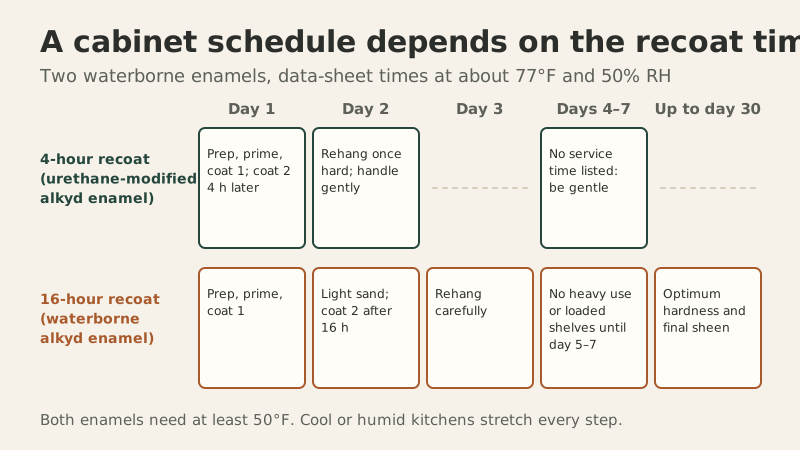
| Waterborne urethane-modified alkyd enamel (Sherwin-Williams Emerald Urethane Trim Enamel, satin) | 1 hour | 4 hours | No service time listed | Above 50°F |
| Waterborne alkyd enamel (Benjamin Moore Advance, satin) | 4–6 hours | 16 hours | No heavy abrasion and no shelves back in service for 5–7 days; up to 30 days for optimum hardness and final sheen | 50–90°F surface |
| Water-based bonding primer (Zinsser Bulls Eye 1-2-3) | About 30 minutes | Topcoat after 1 hour | Full adhesion and hardness in 7 days | Down to 35°F |
Times are the manufacturers' figures at about 77°F and 50% relative humidity. Cool or humid kitchens take longer. Products are examples of each type, not recommendations.
White cabinets and yellowing
Alkyd-based enamels give a hard, smooth finish but can yellow slightly with age. Benjamin Moore's Advance sheet says this is faster in dark or poorly ventilated areas and more visible in light colors, which describes the inside of a closed cabinet. If a bright white matters most, read the data sheet's notes on yellowing before you buy.
Choosing the finish: sheen by room. Why the waits matter: dry time vs cure time. If old cabinet paint is already lifting, see why paint peels first.
FAQ
- Do I have to sand cabinets before painting?
- It depends on the products. Benjamin Moore's Advance data sheet says to roughen all cabinetry by sanding (220 grit or coarser) before priming, while some bonding primers, such as Zinsser Bulls Eye 1-2-3, say they stick to glossy enamel and laminate without sanding. Always degrease first; a light scuff-sand is cheap insurance.
- How long should cabinet paint dry between coats?
- Use the recoat time on the data sheet. In our examples it was 4 hours for a waterborne urethane-modified enamel and 16 hours for a waterborne alkyd, at 77°F and 50% humidity. Allow longer in a cool or humid room.
- When can I rehang cabinet doors and use the kitchen?
- Once the last coat is past its recoat time and hard to the touch, handle doors gently. One waterborne alkyd sheet asks for 5–7 days before heavy abrasion or putting shelves back into service, and up to 30 days to reach full hardness.
- Can you paint laminate or thermofoil cabinets?
- Yes, if the surface is sound. Clean it thoroughly and use a high-adhesion primer made for laminate. Peeling or bubbled thermofoil has to be fixed first, because paint will not hold it down.
- Why do painted white cabinets turn yellow?
- Alkyd-based enamels, including waterborne alkyds, can yellow slightly over time. Benjamin Moore notes this happens faster in dark or poorly ventilated spaces and shows most in light colors.
Sources
- Advance Waterborne Interior Alkyd Satin 792 technical data sheet (Benjamin Moore, PDF)
- Emerald Urethane Trim Enamel, satin, product data sheet (Sherwin-Williams)
- Bulls Eye 1-2-3 Water-Based Primer technical data BEY123-01 (Zinsser / Rust-Oleum, PDF)
- Reduce the Risk of Lead Exposure at Home (US EPA)
Sources checked October 27, 2026. Rules of thumb on this page are our editorial guidance, not standards.