 Color Swatch Lab
Guides · CSL–025
When to remove painter’s tape
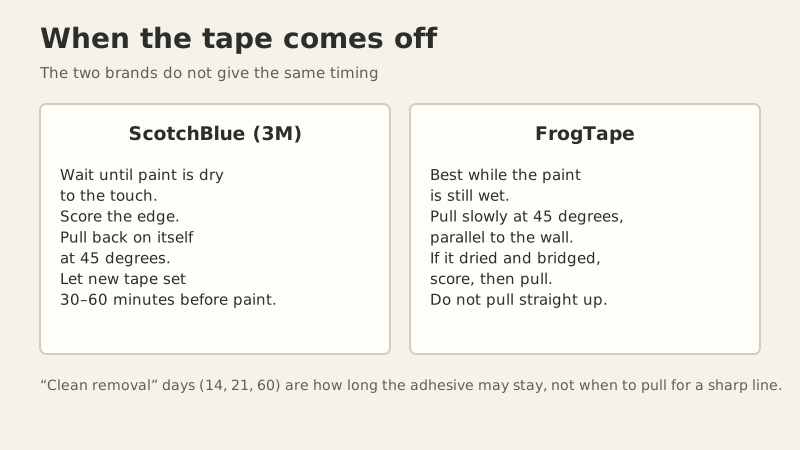
Two instructions, both in print
Painter’s tape fails in two opposite ways. Pull it too late and the dried paint film has bridged from the wall onto the tape, so the film tears or takes a flake of the layer underneath with it. Pull it in a way the adhesive was not designed for, or leave a high-tack tape on too long, and you lift fresh paint or leave adhesive. The annoying part is that the two brands most people actually buy do not tell you the same thing about timing.
3M’s ScotchBlue removal page says to wait until the paint is dry to the touch, and to check the paint can for the manufacturer’s dry times. Then score along the edge of the tape with a putty knife or a razor so you are not asking the tape to rip the paint film. Lift the tape and pull it back on itself at a 45-degree angle. If adhesive is sticking to the surface, they say to try 90 degrees instead. The technical data for ScotchBlue Original 2090 repeats the removal line: dry to the touch, pull back on itself, 45 degrees. It also says to let the tape sit about 30 to 60 minutes after you apply it, before you paint, and to put it on a surface that is clean, dry and dust-free, pressed down firmly. Sharp Lines 2093, the Edge-Lock tape, uses the same removal sentence and the same 30-to-60-minute set time.
FrogTape’s how-to says the opposite about the paint film: for best results, remove the tape while the paint is still wet. Pull slowly at 45 degrees. If you hear ripping, you are going too fast. Pull parallel to the surface, not straight up and not perpendicular. Their FAQ is blunt: all painter’s tapes should be removed while the paint is still wet. If the paint has dried and is cracking along the line or lifting, score the edge with a razor to break the bridge, then remove. Their apply-and-remove page repeats “while the paint is still wet” as step one of removal.
This is not a puzzle to solve by averaging the two. Use the instruction printed for the roll in your hand. If you mixed brands on one job, remove each one the way that brand says. Where a paint’s own data sheet also says something about tape, that sheet governs the paint film, and the tape sheet governs the adhesive.
Dry to the touch is not cured
“Dry to the touch” is the first of three clocks, and it is the only one 3M is talking about. On the interior latex products we have checked, touch-dry is often about an hour at 77°F and 50% humidity, while recoat is 1 to 4 hours and a real cure is days or weeks. FrogTape’s “still wet” means you are pulling tape during that first hour, sometimes within minutes of the last brush stroke along that edge. Neither instruction means “come back next weekend.”
If you are painting two coats, 3M’s removal page is about the paint that is on the tape. People who leave the tape up through both coats should wait until the final coat is dry to the touch before a 3M-style removal, because that is the film that will bridge. FrogTape’s wet-removal advice is harder to reconcile with a second coat: if you need the tape for coat two, you cannot pull it while coat one is wet and also keep the mask. In that case score before removal once you do pull it, which is the fallback both brands describe for a dried bridge. The clocks themselves are in dry time versus cure time.
Clean-removal days are a different number
Every tape also publishes how long it can sit on a surface and still come off cleanly. That number is about the adhesive and the surface, not about the paint drying. Leaving tape up “within the clean-removal window” does not mean the paint line will be sharp. The paint bridge forms as the film dries, which is hours, not days.
| Tape (manufacturer’s claim) | Clean removal up to | Removal timing they state |
|---|---|---|
| ScotchBlue Original 2090 | 14 days | After the paint is dry to the touch; 45 degrees, back on itself |
| ScotchBlue Sharp Lines 2093 | 21 days, interior and exterior | Same as 2090: dry to the touch, 45 degrees |
| FrogTape Pro Grade Blue | 14 days | Best while paint is wet; score if a dried bridge has formed |
| FrogTape Multi-Surface | 21 days | Same wet-removal guidance |
| FrogTape Delicate Surface | 60 days | Same wet-removal guidance; lower tack for fresher or more delicate surfaces |
| FrogTape Pro Grade Orange, and High Bond Exterior | 3 days | Same wet-removal guidance; shorter stay on the surface |
Those windows come from the 2090 data sheet, the 2093 product page, and FrogTape’s FAQ. They apply to the surfaces each product lists, generally smooth or lightly textured paint, trim, tile and glass for the ScotchBlue tapes. A heavily textured wall, a failing old coat, or a just-painted wall can be outside what the adhesive was tested on. FrogTape says to be cautious if the old paint is peeling, bubbling or thick, because that surface may not be a good candidate for tape at all.
Putting tape on fresh paint
Sherwin-Williams’ room-painting lesson says not to tape freshly painted walls beside the trim until the walls are thoroughly dry. That is a longer wait than “dry to the touch,” and it matches the practical failure: tape adhesive can grab a film that feels dry and still lift it. Delicate-surface tapes exist for this. FrogTape rates its yellow delicate tape for a much longer clean-removal window than its pro-grade orange tape, and 3M sells a delicate-surface ScotchBlue with lower tack. “Delicate” still does not mean “five minutes after rolling.” Read the wait on the tape package before you mask a stripe or a two-tone line on new paint.
Press the tape down. Both 3M and Sherwin-Williams treat a floating edge as the reason paint sneaks under. 3M says to press firmly as you go. Sherwin-Williams says to run a putty knife along the edge, and to use longer pieces so you are not stacking seams. FrogTape says to seal the edge with a firm plastic tool, and not to stretch the tape as you unroll it, because a stretched tape pulls back and opens a gap. Give 3M tapes that 30 to 60 minutes of set time before paint hits them. Painting immediately on a tape that has not been pressed can look fine and still bleed.
The pull
- Decide wet or dry from the brand, as above.
- If the paint has dried, score the paint film along the tape edge with a putty knife or razor. You are cutting the bridge, not digging into the wall.
- Pull back on itself at about 45 degrees, slowly, parallel to the surface. FrogTape says ripping sounds mean you are going too fast. 3M says switch toward 90 degrees if adhesive is transferring.
- Do not let a painty length of tape flop back onto the wall. FrogTape says it can re-stick and track residue. Throw it away as you go.
- If a little paint did creep under, touch it up with a barely loaded brush after the film is dry, feathering into the field. Touch-up technique is in flashing and lap marks.
Tape is a tool for the edge. It does not replace cutting in with a brush on every job, and it does not forgive a wall that was dusty or damp when you stuck it down. Prep is how to prep walls. The order of ceiling, walls and trim, which is also when you are allowed to tape the walls, is how to paint a room. Comparing rolls is the painter’s tape gear guide.
FAQ
- Should painter’s tape come off while the paint is wet or dry?
- It depends on the tape. FrogTape says to remove it while the paint is still wet. 3M ScotchBlue says to wait until the paint is dry to the touch. Follow the brand on the roll you used.
- What angle do I pull painter’s tape?
- Both 3M and FrogTape say about 45 degrees, pulling the tape back on itself rather than straight up. FrogTape adds that the pull should be parallel to the surface. 3M says to try 90 degrees if adhesive is sticking.
- What does “14-day clean removal” mean?
- It is how long that tape is rated to stay on the recommended surface and still release cleanly. It is not how long you should wait to pull it for a sharp paint line. The paint film bridges much sooner than that.
- Why did the paint tear when I pulled the tape?
- A dried film had bridged onto the tape, or the tape took a soft undercoat with it. Score along the edge with a blade or putty knife before you pull, and do not tape paint that is only freshly dry.
- How long should tape sit before I paint?
- 3M’s 2090 and 2093 instructions say about 30 to 60 minutes after you press the tape down, on a clean, dry, dust-free surface. Press the edge so paint cannot creep under it.
Sources
- How to Remove Painter's Tape (ScotchBlue / 3M)
- Scotch Painter's Tape 2090 technical data (3M, PDF)
- ScotchBlue Sharp Lines Painter’s Tape 2093 (3M)
- How to Use FrogTape (FrogTape)
- FrogTape FAQs (FrogTape)
- How-To Paint a Room (Sherwin-Williams)
- How to Prep Walls for Painting (Sherwin-Williams)
Sources checked October 27, 2026. Rules of thumb on this page are our editorial guidance, not standards.
Judging a real can of paint, not a screen chip: how to order samples · how we plan to measure color · how to test a sample.