 Color Swatch Lab
Why does wet paint look darker?
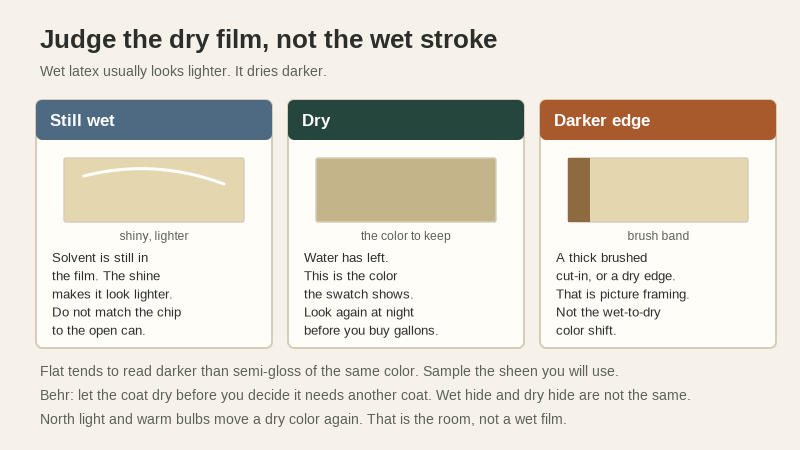
The wet film is not the color
People ask why wet paint looks darker because the wall in front of them does not match the chip. The direction the two paint makers gave Family Handyman is the other way. Fiorilli said that in most cases a paint dries darker than the wet shade, because the solvent evaporates, and that in latex that solvent is water. Bosveld said the paint’s actual color does not change during application or drying. The wet surface, still full of that liquid, is highly reflective, so the color seems lighter. When the film is dry and no longer that reflective, you see the color the swatch was printed to show.
Dunn-Edwards’ ingredients page is the same mechanism without the color adjective. Paint is pigment and binder, the solids, carried in a liquid. In latex that liquid is mostly water. The liquid gets the solids onto the wall and then leaves. What stays is the film. They say higher-quality paints often land around 35 to 40 percent solids by volume, depending on the gloss, and that the solids are what remain after the liquids evaporate. A can that is mostly vehicle cannot look like the thin dry film it will become. That is why the color in the bucket is a bad preview.
| What you are looking at | What the sources say | When it is fair to judge |
|---|---|---|
| Paint in the open can, or a stroke that is still shiny | Fiorilli: it dries darker as the water leaves. Bosveld: the wet surface looks lighter than the true color | After the film is dry, not while it flashes a highlight |
| A coat that looks blotchy or thin while it is wet | Behr says its paints are built for better dry hide than wet hide. The wet film may not look uniform until the moisture leaves and the solids level out | After it dries. Another coat, decided while it is wet, can be wasted |
| A darker band where you cut in with a brush | Sherwin-Williams: the brushed edge is often a thicker film than the rolled field, or the edge had already started to dry | This is picture framing, not the wet-to-dry shift. Fix the technique and recoat |
| A dry wall that still does not match the chip | Sheen, window direction and bulbs change a dry film. The pigment did not “develop” overnight into a new color | On a large dry sample, morning and night, in the sheen you will buy |
Wet hide and dry hide are not the same job
Hiding is whether the film covers what is under it. Color is which hue you see. They move on different clocks, and mixing them up is how a first coat gets a panicked second coat it does not need.
Behr’s pro note, quoting Arek Anysz, splits hide in two. Dry hide is what a fully cured coating does to the surface underneath. Wet hide is what the coating does while it is still wet. He says they manufacture for better dry hide than wet hide, so a product that is wet and still curing may not look uniform. As it dries, the moisture evaporates and the solids tighten and level out. A painter who does not know that will add coats before the first one has dried, trying to fix a patchy look that was going to settle. The instruction is to let it dry, then decide.
Dunn-Edwards’ ingredients page says why the two hides are not the same recipe. Titanium dioxide, the white pigment, contributes to wet hide. Extender pigments, the cheaper fillers, contribute only to dry hide, and they also help set the gloss. A film can look incomplete while it is wet and then cover once those extenders are doing their dry job. The reverse worry, a light color over a dark wall that still ghosts after it dries, is poor dry hide. The causes and the primer step are in painting over a dark color. Do not confuse that ghost with the lighter look of a wet stroke.
The darker edge is usually the brush
There is a real “this looks darker” that shows up before the paint is dry, and it is not the solvent effect. Sherwin-Williams describes picture framing, also called hatbanding: the edges you cut in with a brush look darker than the field you rolled, like a frame around the wall. Sprayed paint can look darker than a brushed or rolled neighbor for the same reason. The causes they list are a thicker film where the brush laid more paint than the roller, a wet edge that was already dry when you rolled into it, and paint that was not mixed, so the settled pigment never got back into the liquid.
Their fix is to stop cutting in the whole room first. Work a small section. Cut in only as wide as you need, usually 1 to 2 inches on that page, and bring the roller as close to the corner as you can. The homeowner room lesson uses a 2- to 3-inch band and the same wet-edge rule. Keep the boundary wet. That idea, the wet edge, is also how you avoid lap marks. A darker rectangle the width of your brush, still shiny, is a film-thickness problem. Let it dry, then recoat the wall from corner to corner if the frame remains. Do not spot-paint the dark line with a second heavy brush load.
Sheen, light and undertone, after it is dry
Once the film is dry, three things still move the color, and none of them is “it is still wet.”
Sheen. Fiorilli told Family Handyman that different sheens look darker or lighter because of how the film reflects light. Flat tends to look darker because it absorbs light. Semi-gloss tends to look lighter because it reflects more. Dunn-Edwards’ gloss bulletin says the same color in different sheens can look like different colors: a higher sheen throws light back at a more predictable angle, and a flat film scatters it. Tilt the same samples and they can look closer, because the angle of the light changed. Buy the sheen you will use. A flat sample does not predict a semi-gloss door. The ladder of finishes is the sheen guide.
Light. Dunn-Edwards says nothing changes color perception more than light, and names illuminant metamerism: the same color looks different under different lamps. Direct sun is their reference for a balanced read. Incandescent and halogen enhance reds and yellows. Fluorescent and many energy-saving lamps enhance blues and greens. Family Handyman’s report of Bosveld matches the room test we already use: a south-facing room can wash a color lighter, a north-facing room can make it look darker, and the only reliable check is to live with a sample. Window direction is north versus south light. Bulb color and CRI are how lighting changes paint color.
Undertone. A wet highlight hides the lean of a neutral. A dry sample next to the floor and the trim shows it. The comparison method is warm versus cool undertones. Family Handyman also notes the room around the sample: the same color looks darker against light furnishings than it does in a room of similar tones. That is context, not a change in the can.
When to judge
- Stir the can before you brush the sample. Family Handyman’s mixing note is that pigment settles, and an unmixed can is not the color you will get on the wall. Sherwin-Williams says the same thing about picture framing: even white has to be shaken.
- Put the sample on a board or a sheet large enough to read, away from the old color if you can. The method is how to test paint samples.
- Let it dry. A wet stroke is the lighter, shinier version Fiorilli and Bosveld described. Behr’s point is the matching one for coverage: decide on another coat after the film has dried, not while it still looks uneven.
- Look more than once. Morning, afternoon and night, under the bulbs that will stay. Bosveld’s line in that article is to sit with a sample for a few days.
- Then compare with the chip. If the dry sample and the chip disagree, believe the sample in your light. If the open can and the chip disagree, believe neither until something has dried on the wall.
The quotations above are from Family Handyman’s October 31, 2023 article, which names Dennis Fiorilli, then Director of Product Excellence at Sherwin-Williams, and Tim Bosveld, then vice president of product management at Dunn-Edwards. This site is not affiliated with those companies or with Behr.
FAQ
- Does paint dry darker or lighter?
- Darker than it looked while wet, in the account Sherwin-Williams’ Dennis Fiorilli gave Family Handyman. The water or other solvent evaporates. Dunn-Edwards’ Tim Bosveld says the color itself does not change: the wet film looks lighter because it is reflective. The chip shows the dry color.
- Why does the cut-in look darker than the rest of the wall?
- Sherwin-Williams calls that picture framing. The brush usually leaves a thicker film than the roller, or you rolled into an edge that had already started to dry. It is not the wet-to-dry color shift. Cut in small sections and keep a wet edge, then recoat the whole wall if the frame remains after it dries.
- Can I tell if one coat is enough while the paint is wet?
- Not reliably. Behr says its paints are made to hide better once they are dry than while they are wet, and that a wet film may look uneven until the moisture leaves. Let it dry, then decide on another coat.
- Does sheen change the color?
- The pigment can be the same and the read can still change. Fiorilli says flat tends to look darker and semi-gloss lighter. Dunn-Edwards says different sheens of one color can look like different colors because of how they reflect light, and that the gap narrows when you change the viewing angle. Sample the sheen you will buy.
- When should I judge a paint sample?
- After it is dry, in the room, more than once. Look in daylight and at night under your own bulbs, and give it a few days. The open can and a wet brush stroke are the lighter, shinier version of the film, not the color you will live with.
Sources
- Do Paints Dry Darker or Lighter? (Family Handyman)
- What Is Paint Made Of? (Dunn-Edwards)
- Solving Common Commercial Paint Challenges (Behr Pro)
- Picture Framing / Hatbanding (Sherwin-Williams)
- Gloss, Lighting and Texture Effects on Color Perception, technical bulletin (Dunn-Edwards, PDF)
- Hiding (Poor): Causes and Solutions (Sherwin-Williams)
Sources checked November 6, 2026. Rules of thumb on this page are our editorial guidance, not standards.
Judging a real can of paint, not a screen chip: how to order samples · how we plan to measure color · how to test a sample.