 Color Swatch Lab
Why is my white paint turning yellow?
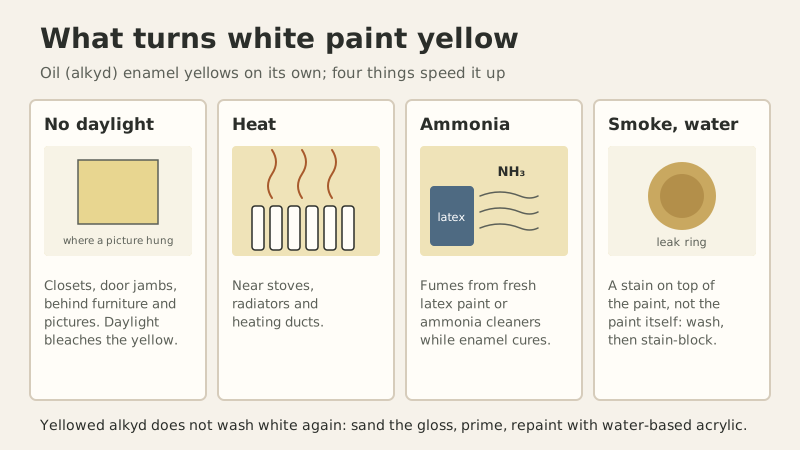
First, is it the paint or something on the paint?
Sherwin-Williams defines yellowing as a yellow cast that develops in aging paint, most noticeable in white paints and clear varnishes. Before you choose a fix, work out whether the paint film itself has changed color or whether something has settled on top of it. Wipe a small area with a damp cloth and a mild cleaner. If the cloth comes away tan or brown and the wall is lighter underneath, you are looking at a deposit such as smoke residue or kitchen grease. If nothing comes off and the yellow is even through the film, the paint itself has yellowed.
| What you see | Likely cause | What fixes it |
|---|---|---|
| White trim, doors or cabinets yellowing, worst inside closets, on door jambs, behind furniture or pictures | Oil-based (alkyd) paint yellowing as it cures and ages, faster without daylight | Sand the gloss dull, bonding primer if needed, repaint with water-based acrylic enamel |
| Yellow near a stove, radiator or heating vent | Heat | Repaint with latex, and expect some yellowing to return if the heat stays |
| Fresh white enamel yellowing within weeks, in a closed-up room painted with latex at the same time | Ammonia vapor from water-based paint or ammonia cleaners reaching the curing alkyd | Let it harden, then sand and repaint with a water-based system |
| Yellow-brown film on walls and ceiling, sometimes sticky, outlines where pictures hung, smells of smoke | Tobacco smoke or other smoke residue | Wash it off, seal with a stain-blocking primer, repaint |
| A brown ring or blotch on a ceiling | A water leak | Fix the leak, let it dry, seal with a stain-blocking primer, repaint |
| Clear finish on wood turning amber | Oil-based varnish, which starts amber and darkens with age | A water-based clear finish if you want less color change |
Why oil-based paint yellows
Alkyd and oil-based enamels harden by reacting with oxygen in the air. A Western Australian Building Commission bulletin, quoting the Australian Paint Manufacturers’ Federation, explains that the vegetable oil in alkyd paint reacts with oxygen as it dries and hardens, and lists household cleaners (especially those containing ammonia) and poor light as things that speed up the yellowing. Dulux’s technical note on yellowing names the cause more precisely: colored compounds called chromophores form while the paint dries. They are sensitive to light and are bleached out by daylight, which is why the yellow is worst in the places that get none: sliding cavity doors, inside door jambs, behind furniture and inside cupboards. Dulux adds that some alkyds yellow more than others depending on the blend of oils in the formula, but all of them can be expected to develop a yellow tone over time.
Sherwin-Williams and Behr give the same list of things that make it worse: heat from stoves, radiators and heating ducts, and lack of light behind pictures and appliances and inside closets. Behr adds exposure to cleaning products that contain ammonia. Sherwin-Williams adds moisture and tobacco smoke or other contaminants. The Building Commission bulletin notes that yellowing is a matter of looks: it does not harm the paint film’s performance.
Newer waterborne alkyd enamels, which many people use on trim and cabinets because they level like oil, are not immune. Benjamin Moore’s data sheet for its Advance waterborne alkyd says it yellows less than conventional alkyds, but that a slight amount of yellowing may occur, faster in dark or poorly ventilated areas and more visible in lighter colors. If you are not sure what is on your trim now, the rubbing-alcohol test in painting over oil-based paint tells you whether it is oil or latex.
The ammonia problem: painting walls and trim at the same time
New white enamel that turns yellow within a few weeks often has a simple cause: the walls were painted with latex in the same closed room while the trim enamel was curing. Dulux says ammonia vapor, which some water-based paints release as they dry, can permanently affect the color of a light alkyd enamel. Its advice is to apply the water-based coats first and let them cure for up to two weeks, longer in cold weather, before starting the enamel work, or to do the enamel first and wait before painting walls. Run fans so the vapor leaves the room. Dulux also notes that low-VOC water-based paints usually do not contain ammonia.
The Paint Manufacturers’ Federation guidance quoted by the Building Commission gives a two-week rule for the period after a white or pale alkyd enamel goes on: ventilate as much as possible, do not apply water-based paint nearby, and do not clean with household products high in ammonia. It also says to avoid painting at high humidity or very low temperatures, which slow drying. Many glass cleaners contain ammonia, so check the label before you spray one near fresh white trim.
Smoke and water stains are a different job
Sherwin-Williams’ staining guide lists tobacco smoke as a cause of yellow stains, along with fire smoke and soot, grease and water. Its fix for smoke and grease is to clean as much as possible off the surface with an appropriate cleaner, then seal the stain before topcoating. For water stains, the source of the water has to be found and repaired first, and the stained area sealed with a primer designed to hold out water stains. Ordinary paint alone tends to let these stains bleed back through. Choosing between stain-blocking primers is covered in when to prime before painting. Sherwin-Williams’ examples for smoke stains include a pigmented shellac primer.
How to fix yellowed trim, doors and cabinets
- Decide whether it needs fixing. Sherwin-Williams says that if there are no other problems and the yellowing does not bother you, repainting is not necessary. Dulux describes the effect as irreversible and often patchy, so cleaning will not bring back the original white.
- Check for lead. Trim and doors in homes built before 1978 may carry lead paint under the newer coats. Test before you sand, and follow lead-safe painting practices.
- Clean. Wash off grease and handprints with a pre-paint cleaner and let the surface dry. Skip ammonia-based cleaners.
- Dull the gloss. Dulux says to let the enamel harden fully, then lightly sand to remove the gloss before repainting. A liquid deglosser can help on detailed trim.
- Prime where needed. Water-based paint needs a bonding primer to hold on hard oil enamel, and smoke or water stains need a stain-blocking primer. The full sequence for oil-painted surfaces is in painting over oil-based paint.
- Repaint with a water-based acrylic enamel. Behr recommends latex paints and waterborne varnishes because they resist yellowing, and Dulux says most water-based acrylic paints will not yellow over time. Give the new coat its full cure before closing doors on it, as covered in why painted doors and shelves stick.
Preventing it next time
- Use a water-based acrylic enamel on white trim, doors and cabinets that live in low light, such as closets, hallways and pantries. Benjamin Moore’s Advance sheet points to dark or poorly ventilated areas as the places where its alkyd yellows faster.
- If you do use an alkyd enamel, paint the walls first, ventilate, and wait before starting the trim.
- Let daylight in. Dulux notes that rooms kept closed until someone moves in are especially prone to early yellowing because they lack both ventilation and daylight. It suggests taking doors off to paint and letting them dry in good daylight.
- Keep fresh white paint away from heat, and clean painted trim with mild soap and water rather than ammonia cleaners. How to wash painted walls covers the technique.
- Choosing a white in the first place is its own decision: see how to choose a white paint.
FAQ
- Why is my white trim turning yellow?
- Usually because it is oil-based (alkyd) enamel. Alkyd paint forms yellow compounds as it cures and ages, and the effect is strongest where there is little daylight, near heat sources, and where ammonia fumes from cleaners or fresh latex paint reach it.
- Does latex paint turn yellow?
- Much less than oil. Behr recommends latex paints because they resist yellowing, and Dulux says most water-based acrylic paints will not yellow over time. Latex walls can still look yellow under smoke or grease residue, which washes off.
- Can you clean yellowed paint back to white?
- Not if the paint itself has yellowed. Dulux calls alkyd yellowing irreversible. Cleaning removes smoke, grease and grime deposits, but yellowed enamel has to be repainted to look white again.
- Why did my new white enamel yellow so fast?
- A common cause is ammonia vapor from latex wall paint or ammonia cleaners reaching the alkyd enamel while it cured, especially in a closed room. Dulux advises letting water-based coats cure for up to two weeks before enamel work, with good ventilation.
- How do I paint over yellowed oil-based trim?
- Clean it, sand the gloss dull, apply a bonding primer made for glossy or oil-based surfaces, and topcoat with a water-based acrylic enamel. Test for lead first in homes built before 1978.
Sources
- Yellowing: problem solver (Sherwin-Williams)
- Yellowing - Paint Problem Solver (Behr Pro)
- Advance Waterborne Interior Alkyd Satin 792 technical data sheet (Benjamin Moore, PDF)
- Yellowing of enamels (Dulux Trade, technical advice)
- Industry Bulletin IB 087/2017: Yellowing of alkyd enamel paints (Building Commission, Western Australia, PDF)
- Staining: problem solver for pros (Sherwin-Williams)
- Reduce the Risk of Lead Exposure at Home (US EPA)
Sources checked November 3, 2026. Rules of thumb on this page are our editorial guidance, not standards.
Judging a real can of paint, not a screen chip: how to order samples · how we plan to measure color · how to test a sample.