 Color Swatch Lab
Guides · CSL–023
When to prime before painting
Primer is a problem-solver, not a tax
A lot of paint packaging says “paint and primer in one.” That phrase is easy to over-read. Benjamin Moore’s note on those products says they are self-priming on most properly prepared surfaces, that one coat is sometimes enough to cover, and that they still recommend two coats for full color and for performance. On bare substrates they recommend two coats. On a previously painted surface, one or two finish coats. The asterisk they add matters: some custom colors need a deep-base primer tinted to a specific formula, and stains, smoke, grease or a very slick surface need a special-purpose primer. “Paint and primer” does not retire those cases.
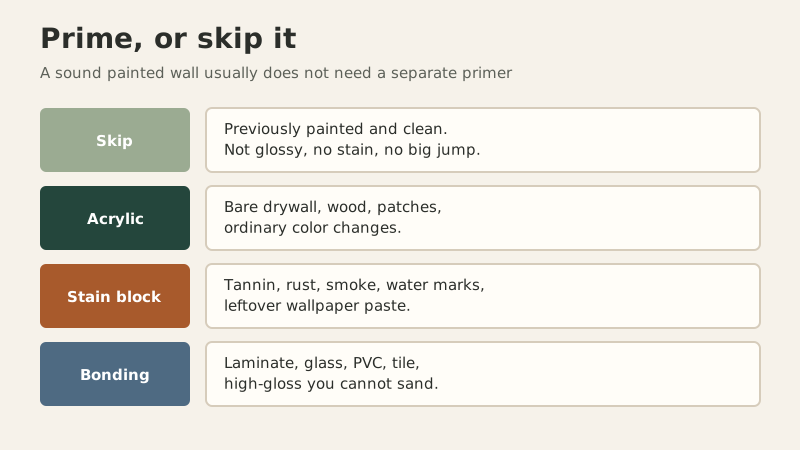
Their primer-selection guide draws the line in one sentence. If the surface was painted before and it is in good condition, you most likely do not need a separate primer. Then they list the jobs where they highly recommend one.
Prime in these cases
| Situation | Why primer helps | Where to start |
|---|---|---|
| Bare drywall, wood, plaster or masonry | Raw surfaces drink paint unevenly, so the finish flashes | An acrylic primer made for that substrate. New plaster needs its cure first; see below. |
| Sanded back to the raw material because of damage | The patch and the bare spot are more porous than the old paint around them | Spot-prime, or the sheen will show the repair. See flashing. |
| Rust, water stains, smoke, crayon, marker | Many water-based finish paints will not lock a stain down | A stain-blocking primer. Alkyd or shellac types for severe bleed. |
| A dramatic color change | A big jump in lightness is a listed cause of poor hiding | A high-hiding primer tinted toward the new color, or the primer shade the color chip names. See painting over a dark color. |
| Plastic, laminate, glass, PVC, high-gloss or other non-porous surfaces | There is little texture for ordinary paint to grip | Dull it if you can, and use a bonding primer. Benjamin Moore points to a waterborne bonding primer for these. |
| Residual wallpaper paste | Paste keeps acting as a release film | Benjamin Moore suggests an alkyd primer to seal leftover adhesive after wallpaper comes off. |
Sherwin-Williams’ note on poor hiding agrees on the color-change and porosity rows. Causes they list include a film that is too thin, a low-hiding paint, a new color much lighter or darker than the old one, the wrong roller nap, a porous surface, poor flow, and thinning the paint. The fixes they list are the labeled film build, a white primer or a primer shaded toward the topcoat (or their P-shade primer), the right nap, priming porous spots, and waiting the full dry time before recoating.
Acrylic, alkyd, or bonding
Benjamin Moore splits ordinary primers into acrylic (water-based) and alkyd (oil-based), then adds specialty products.
- Acrylic primers are the default they describe for most surfaces, including wood, laminate and metal, as long as rust is not the problem. Cleanup is water. Odor and solvent content are lower than a classic alkyd. Their prep guidance points to the Fresh Start primer line when the job is a significant color change on ordinary walls.
- Alkyd primers are the ones they credit with stronger stain blocking: tannin-rich woods, rust, smoke and water stains. They also describe alkyd as a good choice on bare wood, interior or exterior, because it penetrates and holds. The trade-off is solvent, smell and a heavier ventilation requirement. Read what the VOC number means before you open a solvent-borne can in a bedroom.
- Bonding primers are for the surfaces you cannot usefully sand. Benjamin Moore names glossy tile, PVC, vinyl, plastic, glass, glazed block, glossy paint, fiberglass and galvanized metal as the job for its Stix waterborne bonding primer. The product page lists coverage of about 300 to 400 square feet per gallon, application down to 35°F, and soap-and-water cleanup. The surface still has to be clean, dry and free of grease, wax and mildew. “No sanding” is not “no washing.” Old oil-based trim is the most common case in a house; painting over oil-based paint walks through the test and the prep.
- Metal with rust is called out separately. They point to a metal primer, not a wall primer, once the loose rust is off.
A water-based stain blocker we have used as an example elsewhere, Zinsser Bulls Eye 1-2-3, says it bonds to laminate and glossy enamel and lists a topcoat time of about an hour, with full adhesion and hardness in seven days. That is one product’s sheet, not a rule for every bonding primer. The can in your hand wins. Recoat clocks in general are in dry time versus cure time.
New plaster and masonry are a waiting problem
Fresh plaster and some masonry are alkaline and wet. Painting them early is a known way to push the film off later. Data sheets for ordinary wall paints from Benjamin Moore and PPG ask for about a 30-day cure on new plaster before painting. A primer does not cancel that wait. If the plaster is still soft or powdery, it is not ready, primer or not.
How to apply it so the finish coat behaves
- Clean first. The prep sequence is how to prep walls. Primer over grease is a release layer with extra steps.
- Spot-prime repairs even when the rest of the wall does not need a full prime. A spackle patch that goes straight to finish paint often flashes, because the patch absorbs paint differently from the old film around it.
- Tint the primer toward the finish when the color change is large or the new color is deep. A white primer under a deep color makes the finish paint do all of the hiding. Sherwin-Williams’ prep guidance says a darker room is a case for tinted primer rather than white.
- Keep the film at the thickness on the sheet. Spreading primer until it is transparent saves a gallon and fails the hide test. Sherwin-Williams lists “too thin a film” as the first cause of poor hiding.
- Match the roller to the texture. On smooth surfaces they say a mohair, 1/4-inch or 3/8-inch nap is usually enough. Textured surfaces need 3/4 inch or more. The same nap rule applies to the finish coats.
- Let it dry for the time on the primer can before the finish coat. Recoating early can lift the primer or leave lap marks.
What primer does not fix
It does not stick to peeling paint, and it does not stop a water leak. If the old coat is lifting, scrape back to a sound edge first (why paint peels). If the stain is an active leak, the leak comes back through whatever you put on it. Bathroom mold is the same story: the EPA says not to paint or caulk a moldy surface. Clean and dry it, and fix the moisture, before any primer. That is bathroom paint and mildew.
Product names above are examples of a primer type, taken from the manufacturer pages cited. They are not a ranking.
FAQ
- Do I need primer if the can says paint and primer in one?
- Often no, on a clean, sound, previously painted wall. Benjamin Moore still recommends two finish coats for full color, and a separate primer for bare surfaces, stains, a dramatic color change, or a very slick surface.
- What primer blocks water stains and wood tannin?
- Benjamin Moore points to alkyd (oil-based) primers for tannin, rust, smoke and water stains, and says severe bleeding can need a solvent-based primer. A water-based primer is the everyday choice when staining is not the problem.
- Can I paint laminate or glossy tile without sanding?
- Only with a bonding primer made for non-porous surfaces, on a surface that is clean and free of grease. Benjamin Moore names a waterborne bonding primer for glossy tile, PVC, glass and high-gloss paint. Washing still matters.
- Should primer be tinted?
- Tint it toward the finish color when you are making a big color change or using a deep color. Sherwin-Williams also offers gray primer shades matched to specific colors. White primer under a very dark color makes hiding harder.
- How long before I can paint over primer?
- Use the recoat time on that primer’s label. One water-based primer we checked could be topcoated after about an hour at normal temperature and humidity; others differ, and cool or damp rooms take longer.
Sources
- How to Choose the Best Paint Primer (Benjamin Moore)
- How to Prepare Walls for Painting (Benjamin Moore)
- Paint and Primer in One (Benjamin Moore)
- Insl-X Stix Waterborne Bonding Primer (Benjamin Moore)
- Hiding (Poor): Causes and Solutions (Sherwin-Williams)
- How to Prep Walls for Painting (Sherwin-Williams)
- Bulls Eye 1-2-3 Water-Based Primer technical data BEY123-01 (Zinsser / Rust-Oleum, PDF)
- Advance Waterborne Interior Alkyd Satin 792 technical data sheet (Benjamin Moore, PDF)
- PPG Ultra-Hide Zero Interior technical data sheet (PPG, PDF)
Sources checked October 27, 2026. Rules of thumb on this page are our editorial guidance, not standards.
Judging a real can of paint, not a screen chip: how to order samples · how we plan to measure color · how to test a sample.