 Color Swatch Lab
Guides · CSL–027
How to read a paint label
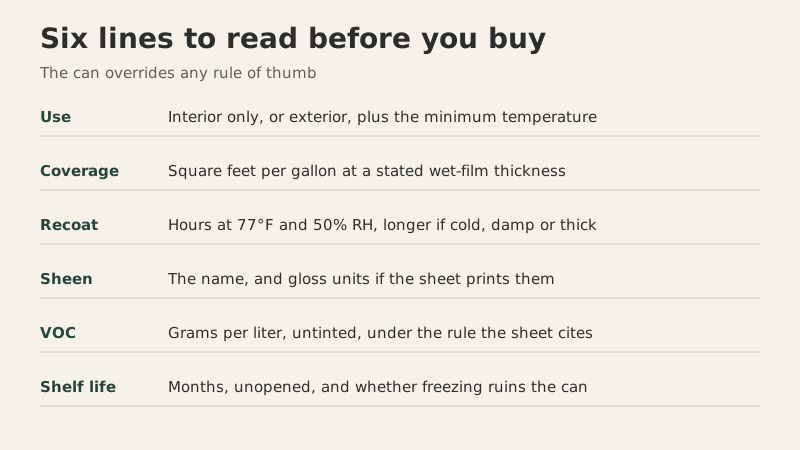
The label and the data sheet are the same conversation
The can in the store carries a short version. The technical data sheet, which manufacturers post as a PDF, carries the numbers the short version is summarizing. When the two seem to disagree, the sheet is usually more specific: it states the temperature, the film thickness and the test method. This page walks one real sheet, Sherwin-Williams SuperPaint Interior Latex Semi-Gloss, A88 series, and then shows how the same lines show up on other products. The numbers below are that product’s, at the revision we read. Another can, even another sheen in the same family, can differ. That is the point of reading yours.
Where you are allowed to use it
SuperPaint A88 says “for interior use only.” That is not marketing. An interior formula is built for scrubbing and washing, not for rain, sun and freeze-thaw. Sherwin-Williams’ contractor FAQ says leftover exterior latex should not be mixed up and used indoors either, because exterior paint is made to stay flexible in weather and is not made for the abrasion interior paint takes. The two directions of the mistake are in interior paint versus exterior paint.
Next to the use line, look for a temperature window and a freeze warning. A88 says to protect the can from freezing. Several other latex paints we have read refuse application below 50°F for air, surface and paint. An exterior low-temperature paint is a different product with a different minimum, sometimes 35°F, and a requirement that the temperature stay there for many hours after you finish. Those limits are in exterior painting weather.
Coverage and the thickness it assumes
A88 lists coverage of 350 to 400 square feet per gallon at 4 mils wet and 1.5 mils dry. The square-foot number is not independent of the mils. Four mils wet is the film they assume when they say a gallon covers that area. Spread the same gallon over more wall and you are under 4 mils, which is the first cause Sherwin-Williams lists for paint that will not hide. Pile it on thicker and you may cover better in one coat, and you will also wait longer to recoat, because the sheet says dry time depends on film thickness.
Use the number as a buying figure, then round up for texture, a porous wall, or a big color change. The arithmetic, including doors and windows, is how much paint you need. If the color is a long way from what is on the wall now, the coverage line still assumes a normal hide, not a miracle. Primer and a second coat are painting over a dark color.
A88 also says that to optimize hide and color development you should use the recommended P-shade primer. That is the gray-primer code Sherwin-Williams prints on colors that need one, from a light gray to a dark gray. It is a label instruction, not an upsell you have to guess at. If your chip has no code, you are not meant to invent one.
Touch, recoat, and the lab conditions
A88’s drying block reads: at 77°F and 50% relative humidity, touch in 1 hour, recoat in 4 hours. Then a sentence that does more work than the numbers: drying and recoat times are temperature, humidity and film thickness dependent. A bathroom that is 62°F after a shower is not that lab. A coat rolled on heavy over a patched wall is not 4 mils everywhere.
Sherwin-Williams’ general room-painting page says people often wait 2 to 4 hours between coats and tells you to check the label, which is exactly this kind of variation. One waterborne alkyd trim enamel from another maker lists 16 hours to recoat. You cannot carry the “about 4 hours” habit from wall latex to cabinet enamel. The three different clocks are explained in dry time versus cure time.
Nothing on the A88 dry-time line tells you when the film can be scrubbed. Washability is a later milestone. Benjamin Moore’s eggshell sheet for Regal Select says walls can be washed after two weeks. A different Benjamin Moore page on freshly painted walls says to wait until the paint is fully cured and, at minimum, 30 days before a real cleaning. When a product sheet and a general article disagree, follow the sheet for that product and the longer wait if you are unsure. Washing technique is how to wash painted walls.
Sheen as a number
A88 calls itself semi-gloss and then gives the measurement: 25 to 35 units at a 60-degree gloss meter. The word “semi-gloss” is not standardized across brands. Another company’s “satin” can land near this range, and another’s “semi-gloss” can be shinier. If you are trying to match an existing trim sheen, the unit number on the two data sheets is a better comparison than the names on the cans. What each step of the ladder looks like in a room is the sheen guide.
The sheet also shows how much colorant each base takes. For A88, a deep base is listed at about 4 to 12 ounces of colorant per gallon and an ultradeep base at about 10 to 12 ounces. That is why a very deep or very clean color can hide less and can pick up more VOC from the colorant than the untinted base’s number suggests. It is also why the store may hand you a different base than the white you were picturing. You do not need to mix that formula yourself. You do need to know that “the same product” in a deep color is not the same can as the extra-white base.
The VOC line, and what it leaves out
A88 lists VOC, less exempt solvents, as less than 50 grams per liter (0.42 pounds per gallon), “as per 40 CFR 59.406.” That citation is the federal architectural-coatings rule. Under that rule the limit for non-flat coatings is 380 grams per liter and the limit for flat coatings is 250. Less than 50 is far under the federal cap. It is also the neighborhood of California’s model limit for wall paint, which is 50 grams per liter for both flat and non-flat. The federal and California numbers, and the fact that colorant added at the store is often outside the tested figure, are in low-VOC paint explained.
A VOC number is not an emissions test, and it is not a health clearance. The cautions on A88 still say to use the paint with adequate ventilation, to open windows and doors, and to get more fresh air, wear the respirator the label calls for, or leave if you get watery eyes, headache or dizziness. They also say to avoid eye and skin contact, wash your hands, keep the can closed, and not to pour it into another container for storage. The first-aid line says to flush eyes with water and, if it is swallowed, to call a poison center or a doctor. Those sentences survive on low-VOC cans. “Low” is not “none,” and it is not “close the room up so the color dries faster.”
Shelf life, freezing, and keeping the lid honest
A88 lists a shelf life of 36 months, unopened. That clock is for a can that has not been opened and has not frozen. Once you open it, introduce air, and get a dirty rim, you are outside that claim. Protecting the can from freezing is on the same sheet: a freeze can ruin the latex emulsion even if the can is still inside its printed shelf life. If you are storing a partial can, seal it the way the disposal and storage guidance describes, label the color and the room, and do not assume a three-year-old opened gallon is the same paint. Leftover handling is how to dispose of leftover paint.
A 60-second check at the store
- Interior or exterior, and the minimum temperature.
- Coverage in square feet per gallon, and whether a film thickness is printed next to it.
- Touch and recoat at a stated temperature and humidity.
- Sheen name plus gloss units, if you are matching a finish.
- VOC in grams per liter, and whether the sheet warns that colorant can raise it.
- Cleanup: soap and water means water-based; mineral spirits means solvent-based. That one line also tells you how you will clean the brush and what you may not pour down a drain.
- Shelf life and the freeze warning, if you will not use the whole can.
Rules of thumb on this site, such as “about 350 to 400 square feet,” are editorial summaries of sheets like this one. The can overrides the summary.
FAQ
- How many square feet does a gallon cover?
- Read the coverage line, which assumes a film thickness. Sherwin-Williams SuperPaint interior semi-gloss lists 350 to 400 square feet per gallon at 4 mils wet and 1.5 mils dry. Texture, porosity and a large color change reduce how far the gallon goes.
- Why does the dry time on the can not match my room?
- The printed time is at a stated condition, often 77°F and 50% relative humidity, at a normal film thickness. Colder air, higher humidity and a heavier coat all lengthen it. The SuperPaint sheet says this explicitly.
- What does “less than 50 g/L VOC” mean?
- It is the volatile organic content of the coating as tested under the federal rule cited on the sheet, 40 CFR 59.406. Colorant added to tint the base can raise the number. It is not a promise about odor or about skipping ventilation.
- Are sheen names the same at every brand?
- No. A data sheet may also list gloss units, such as 25 to 35 at 60 degrees for one semi-gloss. Compare those numbers when you need a finish to match, and test a sample in the sheen you will buy.
- How long can I keep an unopened can?
- The SuperPaint sheet lists 36 months unopened, and says to protect the can from freezing. An opened can is not covered by that figure. Seal it, keep it from freezing, and stir-test it before you trust it for a touch-up.
Sources
- SuperPaint Interior Latex Semi-Gloss A88 product data sheet (Sherwin-Williams)
- Hiding (Poor): Causes and Solutions (Sherwin-Williams)
- Hue and Hide (Sherwin-Williams)
- 40 CFR Part 59 Subpart D: VOC emission standards for architectural coatings, Table 1 (eCFR)
- Regal Select Interior Eggshell 549 technical data sheet (Benjamin Moore, PDF)
- Interior Product Selection FAQs (Sherwin-Williams)
Sources checked October 27, 2026. Rules of thumb on this page are our editorial guidance, not standards.
Judging a real can of paint, not a screen chip: how to order samples · how we plan to measure color · how to test a sample.