 Color Swatch Lab
Guides · CSL–029
Interior paint vs exterior paint
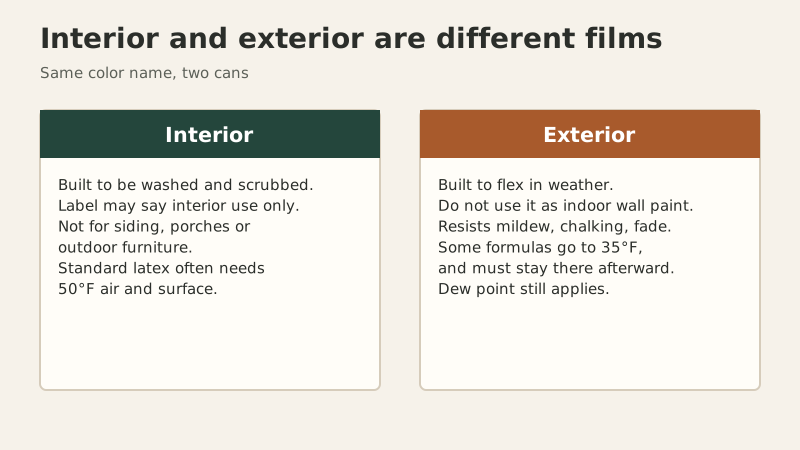
The label line is the rule
The fastest check is three words. Sherwin-Williams SuperPaint Interior Latex Semi-Gloss says “for interior use only.” That product’s coverage, dry time and VOC numbers are discussed in how to read a paint label. The use line is doing a different job from those numbers. It says the formula was not tested or built as an exterior coating. Putting it on siding, a front door that faces the weather, outdoor furniture or a porch deck is outside what the can allows, even if the color is perfect and you have a gallon left over.
The other direction is just as clear, and it is the one people hit when a garage is full of last summer’s house paint. Sherwin-Williams’ interior product-selection FAQ answers the question of mixing leftover exterior latex for an interior primer or topcoat with “no.” The reason they give is specific. Exterior paints are made to be flexible and to withstand weather. They are not made to take the physical abuse, abrasion and scrubbing, that interior paints are made for. They “will not perform properly inside.” That is a manufacturer telling you not to be clever with leftovers. It is not a comment about one bad can.
What each side is asked to survive
Interior walls get hands, backpacks, furniture, cleaning cloths and the occasional splash. The performance Sherwin-Williams talks about for quality interior paint, in its paint-selection guide, is hide, leveling, dirt resistance, scrubbing resistance and resistance to burnishing, the shiny spots from rubbing. Those are indoor insults. A wall that burnishes is a sheen problem you can read about in how to wash painted walls.
Exterior film gets a different list. The same Sherwin-Williams guide describes quality exterior paint as holding color longer, resisting dirt, resisting chalking, resisting mildew, and blistering, flaking and peeling less, because it adheres and stands up to the weather. Chalking and mildew are not the failure modes of a living-room wall. They are what sun, rain and organic growth do to a film that sits outdoors all year. An interior can that has never been formulated or tested against that list should not be asked to pass it.
Benjamin Moore’s exterior temperature guidance, which we use in the weather guide, is aimed at coatings that have to form a film in conditions an interior wall never sees: cold nights, dew, and a surface that can be much hotter than the air when the sun is on it. Interior latex that lists a 50°F minimum and a “do not freeze” warning is not a substitute for an exterior product rated, on its own sheet, down to 35°F or 40°F with a hold time after application. The weather limits are when it is too cold or too hot to paint outside.
A side-by-side of the decisions
| Interior paint | Exterior paint | |
|---|---|---|
| What the maker optimizes | Washability, scrubbing, burnish resistance, appearance under indoor light | Flexibility in weather, adhesion, color retention, mildew and chalking resistance |
| Using it the other place | SuperPaint’s sheet: interior use only. Do not put it outdoors. | Sherwin-Williams FAQ: do not use it as an interior primer or topcoat. |
| Temperature | Often 50°F minimum for standard interior latex. Protect liquid paint from freezing. | Product-specific: some latex at 35°F or 40°F, with hours or days of cure weather required. Dew point matters. |
| Sheen job | Flat hides flaws on ceilings and low-wear walls; higher sheen takes cleaning | Lower sheen is common on siding; gloss shows more on trim. Follow the exterior product’s own sheen list. |
| Moisture | Bathrooms need ventilation and a sheen you can wipe. The paint does not fix a leak. | Rain, dew and sprinklers are design conditions. Fresh film still needs the dry time on the can before it rains. |
The interior column is drawn from the SuperPaint sheet, the contractor FAQ, and Sherwin-Williams’ description of interior performance. The exterior column is drawn from that same FAQ, their quality-selection guide, and the exterior data sheets cited in the weather guide. It is not a lab comparison we ran.
Edges where people talk themselves into an exception
- A covered porch. Still exterior. Temperature swings, humidity and dust are not indoor conditions. If the can says interior only, the porch is not a loophole.
- Outdoor furniture you will store in the winter. Storage does not make the summer an interior. Use a product labeled for the material and for exterior exposure.
- A bathroom, because it gets wet. Wet is not weather. Bathroom walls want an interior paint you can clean, plus a fan that actually exhausts outdoors. Exterior paint’s flexibility does not make it the right scrubbable film, which is the failure the FAQ names. See bathroom paint and mildew and sheen by room.
- Primer leftovers. Primers are labeled interior, exterior, or both. A bonding primer that states both can cross the line. An interior wall primer does not become an exterior wood primer because the can is open. Read the substrate list.
- Trim enamel. Some enamels are sold for interior trim, some for exterior, some for both. The word “enamel” does not settle it. Cabinet enamels we have cited are interior products with long cure times. They are not house paint.
If the wrong paint is already on the surface
Indoors, if exterior paint is on a wall and it is sound, the practical problem Sherwin-Williams names is wear: it may not take scrubbing the way an interior film does. Washing gently, as in the washing guide, is safer than a heavy scour. When you repaint, use an interior finish over a clean, dull, primed-if-needed surface. Do not keep layering exterior paint because it is what you have.
Outdoors, interior paint that has started to crack, fade or peel has to come back to a sound edge before a real exterior system goes on. Peeling causes, moisture above all, are why paint peels. Do not read this as permission to scrape a pre-1978 house without lead-safe practice. That constraint is lead-safe painting, and it applies indoors and outdoors.
Buying so you do not create leftovers of the wrong kind
Buy the interior gallons for the interior job and the exterior gallons for the exterior job, using the coverage on each sheet. A shared color name is not a shared formula. The same brand will tint an interior base and an exterior base to a color of the same name, and the two films will still be different products with different limits. If you are matching a color across a door that has an inside face and an outside face, you may need two cans, one of each, in the same color code. Test both in their real light before you commit. How to test samples applies on the outside face too: sun and shade move, and a sample board tells you more than the lid.
Store the two where the labels stay readable. The expensive mistake next year is grabbing the exterior gallon for a bedroom touch-up because the color name matches. Mark the lid with the room or the elevation, and keep interior and exterior apart. Disposal, when a can really is leftover, is how to dispose of leftover paint. Exterior and interior architectural paints are both in the set PaintCare accepts where that program exists. The use line on the can does not change the disposal line.
FAQ
- Can I use interior paint outside?
- No. Products such as Sherwin-Williams SuperPaint interior latex are labeled for interior use only. Exterior exposure, even on a covered porch or on furniture you store in winter, is outside that label.
- Can I use leftover exterior paint on interior walls?
- Sherwin-Williams says no. Exterior latex is formulated to flex with the weather, not to take the abrasion and scrubbing interior paint is built for, so it will not perform properly inside.
- What is the practical difference between the two?
- Interior performance is about hide, washing and resisting shiny wear spots. Sherwin-Williams describes exterior performance as color retention, dirt and mildew resistance, less chalking, and less blistering or peeling. The lists are not interchangeable.
- Is bathroom paint exterior paint?
- No. A bathroom is an interior surface that gets humid. Use an interior paint in a sheen you can clean, and vent the moisture outdoors. Exterior paint is the wrong answer to steam.
- The color names match. Can I touch up an interior wall with the exterior gallon?
- Do not. Same name and same brand can still be two formulas. Touch up with the interior product that is on the wall, from the can you set aside for that room.
Sources
- SuperPaint Interior Latex Semi-Gloss A88 product data sheet (Sherwin-Williams)
- Interior Product Selection FAQs (Sherwin-Williams)
- A Guide to Quality Paint Selection (Sherwin-Williams, PDF)
- Temperature Guide for Exterior Painting (Benjamin Moore)
- A-100 Exterior Latex Flat A06-Series product data sheet (Sherwin-Williams)
Sources checked October 27, 2026. Rules of thumb on this page are our editorial guidance, not standards.
Judging a real can of paint, not a screen chip: how to order samples · how we plan to measure color · how to test a sample.