 Color Swatch Lab
Why is my exterior paint chalky?
What chalking is
Sherwin-Williams defines chalking as the formation of a fine white powder on the surface of a paint film from weathering, which can make the color look faded. The National Park Service’s brief on exterior paint problems explains the mechanism: the resin that binds the paint slowly breaks down, and how much it chalks depends on the paint’s formula and how much ultraviolet light it gets. Purdue University’s extension bulletin on paint failures places it in the normal life of a paint job. Properly applied paint is not affected by its first two to three years outdoors. After that it gathers some dirt and then enters a flattening stage, when it gradually starts to chalk and erode away. The south and west sides, which get the most sun and rain, wear fastest.
| What you see or feel | What it means | What to do |
|---|---|---|
| Light powder on your hand, color a little faded, paint otherwise sound | Normal weathering | Wash it off. Repainting is optional |
| Heavy powder that coats your hand, color badly washed out | The film is eroding fast. It is near the end of its life, or it was the wrong or a thinned paint | Wash thoroughly, rinse, let dry, re-test, then repaint with a quality acrylic |
| White streaks running down brick or a darker color below painted siding | Chalk run-down: rain carrying chalk onto the surface below | Scrub the stained area with a stiff brush and detergent |
| New paint peeling off older paint in sheets | Paint applied over chalk that was never washed off | Scrape loose paint, wash off the chalk, prime as needed, repaint |
| Thick chalk on factory-finished siding | Factory finishes can build a heavy chalk layer | Power wash before painting |
When chalking is fine, and when it is not
Sherwin-Williams calls some chalking a normal and even desirable way for a paint film to wear. The National Park Service brief goes further and calls moderate chalking the ideal way for a paint to age, because rainwater rinses the chalk off, carries dirt and discoloration with it, and leaves a good surface for the next coat. Excess chalking is the problem. The brief says heavy chalk washes down onto surfaces of a different color and streaks them, and the paint film itself wears away quickly.
Sherwin-Williams lists the usual reasons for heavy chalking. Oil-based paints chalk more than latex. Low-grade, highly pigmented paint chalks. So does interior paint used outdoors, paint over a porous surface that was never sealed, paint that was over-thinned, and paint that was spread too thin. The National Park Service adds that paint with too much pigment for its binder chalks heavily. It notes that the old white lead and oil paints often did, which is one reason to be careful with the powder on an older house (see below). Why interior paint does not belong outside is covered in interior versus exterior paint.
The wipe test
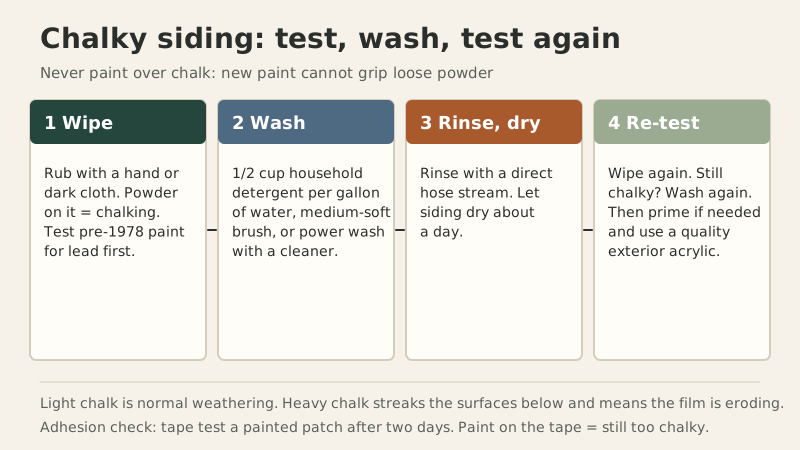
Purdue’s instructions for preparing old paint include a simple check. After washing, wipe the surface with your hand. If it is still dirty or chalky, scrub it again with detergent and rinse with clean water. A dark cloth shows the powder more clearly than skin does. Test the sunny walls as well as the shaded ones, because they weather at different rates. Purdue also gives an adhesion check for the new paint: paint a small area, let it dry for two days, press an adhesive bandage onto it and snap it off. If paint comes away on the bandage, the old surface is still too chalky. Clean it again or use an oil-based primer.
Why you should not paint over chalk
Chalk is loose powder, and paint cannot hold onto a layer that is not attached. Benjamin Moore’s masonry sealer data sheet names painting over chalk deposits as a common cause of peeling and scaling on masonry, and says power washing is the most practical way to remove chalk. The National Park Service brief explains why the type of paint matters: latex applied over old, chalking oil paint can peel because the latex cannot penetrate the chalky surface and grip. Sherwin-Williams’ exterior preparation FAQ is blunt. Any surface that has a chalky feel should be cleaned to remove the chalk before painting. If new paint is already peeling off older paint, why paint peels covers that repair.
How to clean chalky siding
- Check for lead first. In homes built before 1978, old exterior paint may contain lead, and the EPA notes that soil near the walls of buildings painted with lead-based paint often has higher lead levels. Test before you wash, scrape or sand, and follow lead-safe painting practices.
- Wash with detergent. The National Park Service recommends 1/2 cup of household detergent in a gallon of water, scrubbed on with a medium-soft bristle brush. Sherwin-Williams says to rinse or power wash with an appropriate cleaner, wash a second time if chalk remains, and scrub if needed. Its FAQ suggests pressure washing with a detergent injector for chalky siding.
- Rinse thoroughly. Rinse with a direct stream of water from a garden hose, as the National Park Service describes. Detergent left on the wall is another layer the paint has to stick through.
- Let it dry, then test again. Sherwin-Williams’ FAQ says to let siding dry for a day or so after pressure washing. The National Park Service says to repaint once the surface is thoroughly dry, but not to wait so long that chalk starts forming again. Do the wipe test before you open a can.
- Clean the run-down. Sherwin-Williams says brick stained by chalk run-down should be scrubbed with a stiff brush and detergent. Heavy staining may need professional cleaning. Painting brick is its own decision, covered in how to paint brick and concrete.
Vinyl siding needs a gentler hand. Sherwin-Williams’ FAQ says to clean vinyl with a power washer or warm soapy water, and warns that wire brushing or sanding can mar it for good.
Repainting so it chalks less
Sherwin-Williams says that if the chalk washes off and the paint is otherwise sound, you do not have to repaint. When you do, it recommends a high-quality acrylic coating for the best resistance to chalking. The National Park Service likewise says to repaint with a non-chalking paint. If the bandage test showed weak adhesion, prime first. Use the full coverage rate on the label rather than stretching the paint, because Sherwin-Williams lists paint spread too thin as a cause of chalking. Plan quantities with how much paint you need, and pick a dry, mild stretch of weather using exterior painting weather.
FAQ
- What is the white powder on my house paint?
- It is chalk: paint pigment left loose on the surface as sunlight breaks down the paint’s binder. Some chalking is normal weathering. Heavy chalking means the paint is wearing out or was a poor match for outdoor use.
- Is paint chalking bad?
- Light chalking is normal and lets rain carry dirt away. Heavy chalking streaks the surfaces below, fades the color, and means the film is eroding, so plan to wash and repaint.
- Can I paint over chalky paint?
- No. Wash the chalk off, rinse, let it dry and test again first. Paint over chalk cannot bond well and tends to peel. Benjamin Moore names painting over chalk deposits as a common cause of peeling on masonry.
- How do I get chalk off siding?
- Scrub with detergent and water (the National Park Service suggests 1/2 cup of household detergent per gallon) or power wash with a cleaner. Rinse well with a hose, let it dry, and wipe again to make sure it is gone.
- What paint chalks the least?
- Sherwin-Williams recommends a high-quality exterior acrylic for the best chalk resistance. It says oil-based paints chalk more than latex, and low-grade, over-thinned or interior paints used outdoors chalk heavily.
Sources
- How to fix paint chalking (Sherwin-Williams Project Center)
- Chalking: problem solver for pros (Sherwin-Williams)
- Preservation Brief 10: Exterior Paint Problems on Historic Woodwork (National Park Service, PDF)
- Paint Failure Problems and Their Cure, NCR-133 (Purdue University Cooperative Extension)
- Exterior Surface Preparation FAQs (Sherwin-Williams)
- Ultra Spec Masonry Interior/Exterior 100% Acrylic Sealer 608 technical data sheet (Benjamin Moore, PDF)
- Reduce the Risk of Lead Exposure at Home (US EPA)
Sources checked November 3, 2026. Rules of thumb on this page are our editorial guidance, not standards.
Judging a real can of paint, not a screen chip: how to order samples · how we plan to measure color · how to test a sample.