 Color Swatch Lab
Why are water stains coming through my paint?
Name the mark before you open a can
A water stain is discoloration left by water that came from somewhere else: a roof leak, a plumbing drip, a overflowing tub, or a window that leaked into the wall. It is often a yellow, tan or brown ring or map on a ceiling, sometimes with a darker center. The paint around it may still be stuck, or it may have peeled. Finish paint laid over that mark, even in two coats, often lets the stain return as the new film dries. Sherwin-Williams groups this with other bleed-through problems, water, smoke, grease, rust, and it treats water as its own repair: stop the source, then seal.
| What you see | What it usually is | Where that repair lives |
|---|---|---|
| A yellow or brown ring or blotch on a ceiling or wall, often after a leak, with no bare wood in the stain | A water stain in the paint or the board, from water that arrived and dried | This page. Fix the leak, dry the surface, seal with a stain-blocking primer, then paint |
| A brown or yellow spot the shape of a knot, or streaks that follow the grain on cedar, redwood or pine | Tannin from the wood itself | Wood tannin bleed |
| Tan, glossy or sticky drips on latex that is only days old, after a shower or a damp night | Surfactant leaching from uncured paint, not a leak stain | Surfactant leaching. Wash it. Do not prime over it |
| Red-brown dots or streaks over nail heads or bare metal | Rust. Sherwin-Williams splits this from water stains | Remove the rust with a brush or a power tool, then a rust-inhibiting primer, not a wall sealer alone. See how to paint rusty metal |
| The paint film lifting, with bare board under it, in a wet room or under a leak | Moisture peeling, not only a stain | Why paint peels. The leak still comes first |
The shape is the first clue. A knot prints a knot. Fresh latex that weeps after steam is sticky and has no leak above it. A ceiling ring under a bathroom or a roof valley is this page. If you are not sure the leak is dead, wait. Primer does not waterproof a roof.
Stop the water, then judge the surface
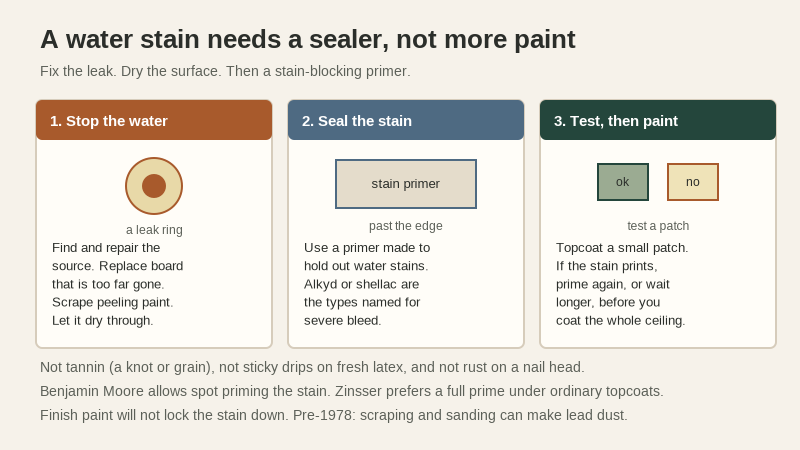
Sherwin-Williams puts the order in one paragraph. The source of the water must be found and repaired. Excessively damaged wood, plaster or drywall may need to be replaced. Peeling paint must be removed if it is present. Only then is the stained area sealed with a primer designed to hold out water stains. Painting first, and hunting the leak later, means you will do this twice.
Let the area dry until it is dry all the way through, not only dry to a fingertip on a warm afternoon. The Zinsser B-I-N sheet is the only source here that prints a moisture number: substrate moisture should not exceed 12 percent, and you should not apply that primer if the surface is within 15°F of the dew point, or if relative humidity is 70 percent or higher. Use those limits when you are using that primer. For any primer, a still-damp board will keep feeding the stain. Soft, sagging or crumbling drywall is past a prime-and-paint repair. Replace it, then treat the new board as new drywall after the leak is gone.
If the house was built before 1978, treat scraping and sanding as a lead-dust job until you know the old film is not lead paint. Sherwin-Williams’ staining page points at its lead notice. The homeowner steps are lead-safe painting.
Seal the stain. Finish paint is not the sealer
Benjamin Moore’s ceiling FAQ is blunt about the chemistry. Stain-blocking primers suppress stains from smoke, tannins or water. Without a primer, those stains can come through after painting. Its primer-selection guide says alkyd primers offer superior stain blocking for tannin-rich woods, rust, smoke or water stains. That is the type they name for this job, not a generic wall primer and not “another coat of the ceiling paint.”
They also sell a water-based stain blocker, Insl-X Aqua Lock Plus, whose product page claims blocking of water stains, tannin, smoke and crayon, with a recoat of one hour at 77°F and 50 percent relative humidity. That page is their water-based example, not a reason to ignore the alkyd line on the primer guide. Use one product, follow that can, and do not blend an alkyd instruction with a latex dry time.
The Zinsser B-I-N shellac-base primer data sheet (BIN-03) is more specific still. It says one coat effectively blocks stains including water, and that some stains require a second coat. It recommends the primer for permanently sealing heavy fire and water stains. Surfaces should be clean, dry and sound. Remove existing stains by washing, sanding or scraping as needed. Do not thin it. At 70°F and 50 percent relative humidity it is dry to the touch in 20 minutes and recoatable in 45 minutes, with full adhesion in one to three days. Cooler air, higher humidity or tint stretches those times. The sheet also limits exterior use to spot priming, and it is not for floors, decks, or a surface that stays wet. Interior ceilings and walls are the usual job.
A practical test sits on the KILZ Restoration primer page, a water-based stain blocker listed for heavy water damage. After priming, apply the topcoat to a small section. If the stain bleeds through that topcoat, apply a second coat of primer and test again before you topcoat the whole area. If bleeding continues, a longer dry time is needed before topcoating. Do not thin the primer for a stain-blocking job. That test is the one worth copying even if you bought a different sealer. It tells you whether the stain is actually locked down, which a glance at white primer often will not.
Spot prime the stain, then decide how much ceiling to paint
Benjamin Moore’s ceiling FAQ says to consider priming just the stains, spot priming, instead of covering the entire wall. The Zinsser sheet allows spot priming only under high-hiding topcoat finishes, and says that for best results you should prime the entire surface before painting. Sherwin-Williams’ interior prep page has a different warning that is easy to mix up with this one. On previously painted surfaces, it says to prime all bare areas, and to avoid “spot priming,” which can leave a non-uniform appearance between primed and unprimed areas. That line is about bare patches versus old paint, and about holdout, not about whether a stain sealer may be brushed only over a ring.
Do not average those three sentences into one rule. Seal every part of the stain, and a little past its edge, with the stain-blocking primer. If the ceiling paint is a flat that hides well, a spot-sealed ring plus a full finish coat can disappear. If a primed patch still flashes, which is a sheen mismatch rather than the stain returning, treat it as flashing: the sealer did its job, but the eye still sees the patch. Then prime or paint a larger field, often the whole ceiling, so the sheen matches. The stain test still comes first. A matched ceiling paint will not block a stain that the primer left alive.
Sherwin-Williams’ paint-prep page names a primer-sealer as the way to seal water, smoke, ink, pencil or grease stains. That product name is their example, not a ranking. Once the sealer has passed the test, apply the finish coats at the spread rate on the can. Recoat clocks are in dry time versus cure time. The primer types in general, acrylic versus alkyd versus bonding, are in when to prime.
Product names above are examples of a primer type, taken from the manufacturer pages and data sheets cited. They are not a ranking. This site is not affiliated with those brands. In a pre-1978 house, follow the lead-safe steps before you scrape or sand.
FAQ
- Why does the yellow stain come back after I paint the ceiling?
- Ordinary finish paint does not lock a water stain down. Sherwin-Williams says to repair the water source, replace badly damaged material, remove peeling paint, and seal the stain with a primer made to hold out water stains. Benjamin Moore’s ceiling FAQ says that without a stain-blocking primer, water, smoke or tannin stains can come through after painting.
- Do I have to prime the whole ceiling?
- Benjamin Moore says you can prime just the stains. Zinsser’s B-I-N sheet allows spot priming only under a high-hiding topcoat and prefers a full prime for best results. Seal the whole stain either way. If the patch still shows as a sheen difference after the stain is blocked, paint a larger field so the sheen matches.
- Which primer blocks water stains?
- Benjamin Moore’s primer guide points to alkyd primers for water stains, rust, smoke and tannin. A shellac-base primer data sheet, Zinsser B-I-N, says one coat usually blocks water stains and some stains need a second coat. Water-based stain blockers also exist; follow the can you bought, and test a small topcoat patch before you do the whole ceiling.
- The stain is still printing through the primer. Now what?
- Add another primer coat and test a small area of finish paint again. The KILZ Restoration page says that if bleeding continues after a second primer coat, the primer needs a longer dry time before topcoating. More finish paint will not finish the sealing job.
- Is a brown ceiling ring the same as tannin or those sticky bathroom drips?
- Usually not. Tannin follows wood grain or a knot. Sticky tan drips on latex that is only days old are surfactant leaching, which you wash off. A ring under a leak, with no bare wood in the mark, is a water stain. Rust on nail heads is a different primer job: take the rust off first.
Sources
- Staining: problem solver for pros (Sherwin-Williams)
- How to Paint Prep (Sherwin-Williams)
- How to Choose the Best Paint Primer (Benjamin Moore)
- How to Paint a Ceiling (Benjamin Moore)
- B-I-N Shellac-Base Primer technical data BIN-03 (Zinsser / Rust-Oleum)
- KILZ Restoration Interior Primer (Behr Pro / Masterchem)
- Insl-X Aqua Lock Plus Primer (Benjamin Moore)
- Reduce the Risk of Lead Exposure at Home (US EPA)
Sources checked November 10, 2026. Rules of thumb on this page are our editorial guidance, not standards.
Judging a real can of paint, not a screen chip: how to order samples · how we plan to measure color · how to test a sample.