 Color Swatch Lab
Why is my paint sagging or running?
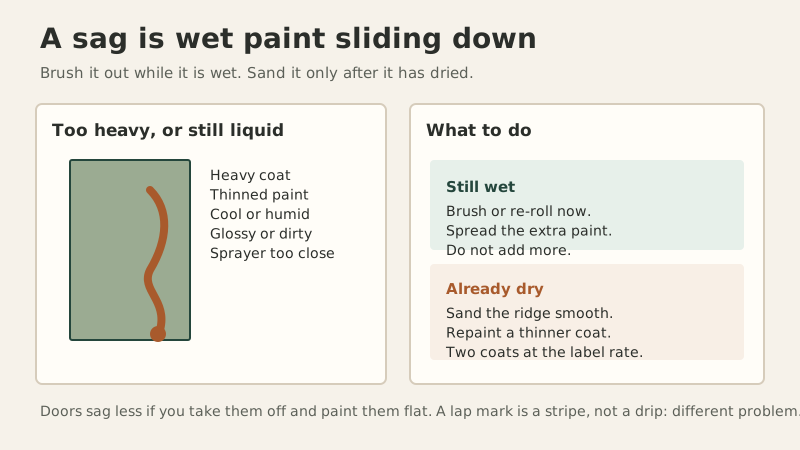
A sag is not a lap mark
Sherwin-Williams defines sagging as the downward droop of the paint film right after you apply it, leaving an uneven coating. Behr uses almost the same words: a downward drooping movement immediately after application. You can see it while you are still working. A run is a single drip. A curtain is a wide sheet of paint that slid and then set as a fat horizontal ridge. It is thickest at the bottom of the slide.
A lap mark is a different failure. That is a stripe where wet paint overlapped an edge that had already started to dry, so the overlap is darker or shinier. Sags run downward because of gravity. Laps follow the path of the roller or the brush. If the wall looks patchy in sheen but nothing actually ran, read flashing and lap marks instead of sanding a drip that is not there.
| What you see | Likely cause | What to do |
|---|---|---|
| Drips or a curtain, and the paint is still wet | Too much paint in one pass, or the film is staying liquid | Brush or re-roll immediately. Spread the excess. Do not add paint |
| A hard ridge you can feel with a fingertip | A sag that dried | Sand it smooth, wipe the dust, repaint a thinner coat |
| Sags on a cold or muggy day, with a normal-looking load on the brush | Cool or humid air slowed the set | Stop, or switch to thinner coats. Check the temperature window on the can |
| Sags only on glossy trim or a door | The surface has little tooth, or the brush flooded the grooves | Sand the gloss dull. On trim, do not fill the profiles. See how to paint a room |
| Curtains under an airless sprayer, not under the brush | The gun was too close, or it moved too slowly | Behr’s note: back off and keep the gun moving. Sand dried runs and repaint |
Why the paint slid
Both Sherwin-Williams and Behr start with a coat that is simply too heavy. Paint is a liquid until it sets. On a vertical wall, a thick film has more weight than the surface can hold, so it creeps down until the solvents leave and it locks in the shape of the drip. The second shared cause is thinning. Both say not to thin the paint unless the label or the data sheet says you can, and not past the amount they name. Thinned paint is wetter for longer and has less body, so it runs. The third is the room or the weather. Excessively cool or humid conditions keep the film open. Outdoors, the temperature, dew point and rain limits are in exterior painting weather. Indoors, a can that lived in a cold garage, or a room with the windows shut on a damp day, does the same thing to a wall.
The surface matters too. Sherwin-Williams lists painting over a glossy surface, and painting over a contaminant such as grease or dust. Behr describes the glossy case as a slick surface without enough tooth for the new paint to stick, so the film sits on top and can slide. Old oil enamel on trim is a common version of that gloss. The test and the bonding step are in painting over oil-based paint. A kitchen wall that was not washed is the contaminant case. Washing and drying come before any coat: how to prep walls.
Behr adds one cause the brush-and-roller pages skip. Airless spraying sags when the gun is too close to the surface or when you move it too slowly, because both put down more paint than the wall can hold. The fix is the same idea as the brush: less paint per pass, and keep moving. This page does not set a pressure or a tip size. Those belong on the sprayer and on the paint’s data sheet.
Fix it wet, or sand it dry
- If you can still move the paint, move it now. Sherwin-Williams and Behr both say to brush out or re-roll immediately so the excess spreads evenly. Work the drip upward and outward into paint that is still wet. A dry edge next to a wet repair becomes a lap, so stay inside the wet area or keep a wet edge as you go.
- If it has skinned over or dried, leave it. Brushing a half-dry drip tears the film and makes a worse ridge. Wait until it is dry enough to sand. Then sand the ridge level with the wall, wipe the dust, and repaint. In a house built before 1978, sanding old paint can release lead dust. Read lead-safe painting before you sand trim or siding of that age.
- Repaint thinner. Both companies say two coats at the recommended spread rate are better than one heavy coat. The number is on your can, not a universal gallon. How to read that line, and a worked room example, is how much paint you need. Stretching the same gallon until it is transparent is the opposite mistake, poor hiding, covered in painting over a dark color.
- Doors are easier flat. Behr suggests taking doors off and painting them supported horizontally, so gravity is not pulling the film down the face and the edges. That is a good use of a slow enamel. Keep the door’s drying time in mind before you hang it: dry time versus cure time and why painted doors stick.
How to keep the next coat from running
- Load the brush, then tap it on the inside of the can. A brush that is soaked to the ferrule dumps paint at the heel, and that dump becomes a run. The room-painting guide covers the same brush handling.
- On trim, brush along the board and do not flood the grooves. Paint that pools in a profile can wrinkle as well as run. That warning is in how to paint a room.
- Sand gloss dull, and wash off grease, before you start. A slick or dirty surface is on both cause lists.
- Stay inside the temperature and humidity range on the label. If the room is cold, warm the can and the room, or put on less paint per pass. Do not thin the paint to make a cold room easier unless the data sheet tells you to.
- With a sprayer, if the first pass curtains, the next pass needs less material, not a second coat on top of the run.
FAQ
- Can I brush out a paint drip?
- Yes, if the paint is still wet. Sherwin-Williams and Behr both say to brush or re-roll immediately so the extra paint spreads evenly. Once the drip has dried, sand it smooth and repaint. Brushing a half-dry drip tears it.
- Why did my paint run when I did not use that much?
- Cool or humid air keeps the film liquid longer, so a normal load can still sag. Over-thinning does the same thing. A glossy or greasy surface gives the paint less to hold onto. Check the conditions on the can before the next coat.
- Should I thin paint so it does not sag?
- No, unless the label or the data sheet says to thin it, and then only by the amount they name. Sherwin-Williams and Behr both list over-thinned paint as a cause of sagging, not a cure.
- Are two thin coats really better than one thick one?
- That is what both companies say. Two coats at the spread rate on the label level out and sag less than one heavy coat. The coverage number on the can already assumes a film thickness. Piling paint on to finish in one coat is how the drips start.
- How do I paint a door without runs?
- Behr suggests taking the door off and painting it supported horizontally, so the film is not hanging on a vertical face. Sand any gloss first, keep the coats thin, and let the enamel dry for the time on the can before the door goes back up.
Sources
- How to Fix Paint Sagging (Sherwin-Williams)
- Sagging Paint, paint problem solver (Behr Pro)
- Reduce the Risk of Lead Exposure at Home (US EPA)
Sources checked November 4, 2026. Rules of thumb on this page are our editorial guidance, not standards.
Judging a real can of paint, not a screen chip: how to order samples · how we plan to measure color · how to test a sample.