 Color Swatch Lab
Why is my paint wrinkling?
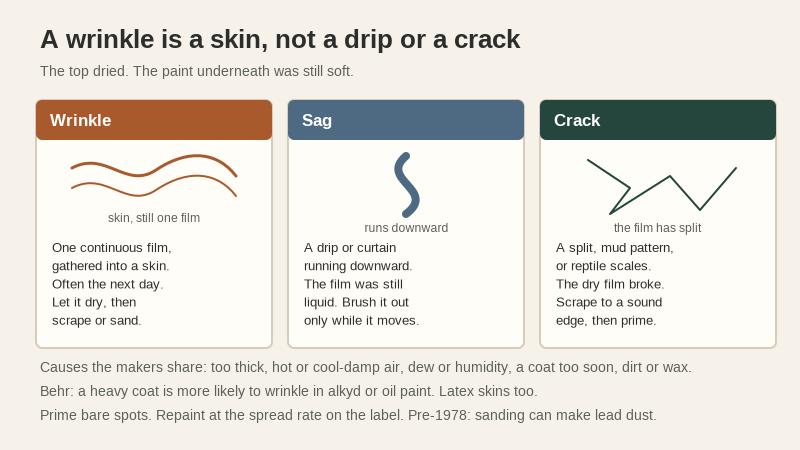
Name the failure before you sand
Four things get called “the paint went wrong,” and only one of them is a wrinkle. Sherwin-Williams describes wrinkling as a rough, crinkled surface that happens when uncured paint forms a skin. The National Park Service brief on exterior woodwork says the top layer dries first and then actually moves while whatever is underneath, often a primer, is still drying. The film stays continuous. It looks gathered, like a skin that shrank, rather than like a tear.
| What you see | What it is | Where that repair lives |
|---|---|---|
| A crinkled skin, often the day after painting, still one film | Wrinkling: the surface skinned over soft paint | This page. Let it dry, then scrape or sand, prime bare spots, repaint thinner |
| A drip, curtain or thick ridge running downward | Sagging: wet paint slid while it was still liquid | Why paint sags |
| Deep irregular splits, like dried mud, often in a corner | Mud cracking: a thick coat shrank and split as it dried | Why paint cracks |
| Connected scales, like a reptile, in old paint | Alligatoring: a hard coat over a softer one, or oil paint that aged brittle | The same cracking guide |
| Bubbles that lift off the surface | Blistering from heat or from moisture behind the film | Why paint bubbles |
Mud cracking and wrinkling can share a cause, a coat that was too heavy, and they are still different damage. A mud crack is a split. A wrinkle is a fold in a film that has not split. Alligatoring is a later pattern in paint that has already hardened, often over years. A wrinkle shows up while the coat is curing, which is why Sherwin-Williams’ exterior troubleshooting FAQ answers a “the next day” question with wet-film thickness and a second coat that went on too soon.
Why the skin forms
Sherwin-Williams’ problem solver and its repair page list the same five causes. Behr’s problem solver lists the same five, with two useful extras in the wording.
- The coat was too heavy. Behr says this is more likely with alkyd or oil-based paint. Sherwin-Williams does not limit the problem to oil. A profile, a corner or a door edge is where a brush dumps paint and the skin forms first. That is the flooded-groove case on trim and on sags: the same puddle can run, wrinkle, or do both.
- The top dried faster than the bottom. Both companies name extremely hot weather and cool, damp weather. The National Park Service adds inadequate brushing-out, and painting above the temperature the manufacturer recommends. Benjamin Moore’s exterior temperature page, already used in the weather guide, lists wrinkling with poor flow, blistering and peeling when sun drives the surface hotter than the air.
- Moisture hit paint that had not cured. Sherwin-Williams names rain, dew, fog or high humidity on the uncured film. Behr names high humidity. A coat that looked fine at 4 p.m. can be wrinkled in the morning if dew sat on it. The dew-point margin and the rain window are in the weather guide. They are how you avoid this cause, not a second repair.
- The coat underneath was not cured. A topcoat on a primer or a first coat that is only dry to the touch skins over a soft layer. Dry to the touch, recoat and cure are three different clocks. The recoat line on the can is the one that matters here.
- The surface was dirty or waxy. Both companies name dirt or wax. Paint that cannot grip sits in a thicker layer and skins. Wash first. That step is how to prep walls.
Sherwin-Williams’ contractor FAQ is the shortest version of the first two causes, and it is worth keeping separate because the repair line is slightly different. Wrinkles the day after siding was painted mean the wet film was thicker than the sheet allows, or two coats went on too quickly to dry. They say to correct it once the film has dried, by power sanding, then to prime the smooth area with a quality oil or latex primer before the topcoat. The homeowner problem solver does not require a power sander. It says scrape or sand. Use the milder tool that actually removes the skin. Power sanding is their answer for a large exterior area that has already dried, not a requirement for a wrinkled door.
The repair, after the film has dried
- Stop brushing it. A wet sag can be brushed out, which is the sagging guide’s first step. A wrinkle that has already skinned will tear if you keep working it. Leave it until the film is dry enough to sand. Sherwin-Williams’ FAQ says “once the paint film has dried.”
- If the house was built before 1978, treat the dust as lead until you know otherwise. Sherwin-Williams’ wrinkling page points at its lead notice. Scraping and sanding old paint can make lead dust. The EPA’s homeowner steps are lead-safe painting: wet methods where you can, keep the dust contained, and do not dry-sand a suspect film.
- Scrape or sand the wrinkled coating off and feather it into the sound paint around it. The National Park Service puts scraping and hand sanding ahead of mechanical sanding for wrinkling, the same order it uses for crazing and intercoat peeling. Sherwin-Williams says to get the surface smooth and thoroughly clean.
- Prime the bare spots and let that primer dry completely. Bare wood, plaster or patched compound is the “if needed” on their page. A wrinkled film you sanded back to the old sound coat may not need a full prime. A spot you took to raw substrate does. The primer categories are when to prime.
- Repaint at the spread rate on the label, in conditions the label allows. Behr says to avoid temperature and humidity extremes and to put on an even coat. Two ordinary coats are the point. One heavy coat is how the skin happened.
How the next coat stays flat
Read the wet-film or spread-rate line before you open the can. Stretching paint until it is transparent is a different failure, poor hiding, covered in painting over a dark color. Piling it on to hide the old color in one pass is this failure. A shorter nap on smooth walls puts down less paint per pass. Sherwin-Williams’ mud-cracking note, which is about a thick film that splits rather than wrinkles, still has the useful nap numbers: 1/4 or 3/8 inch on a smooth surface, 3/4 inch or more on texture. The cover guide is rollers and nap length.
Outdoors, follow the shade, stay above the dew point by the margin on the label, and stop early enough that dew does not land on a soft film. Indoors, a cold can and a closed damp room do the same job as a cool damp exterior. A hygrometer tells you whether “it feels fine” is actually the humidity the label assumes. Do not thin the paint to make a heavy coat flow unless the data sheet says you may, and not past the amount it names. Thinning is a sag cause. It is not a wrinkle cure.
Product names on the manufacturer pages are their examples of a primer. They are not a ranking. This site is not affiliated with those brands. In a pre-1978 house, follow the lead-safe steps before you sand.
FAQ
- What does wrinkled paint look like?
- A rough, crinkled skin in a film that is still continuous. Sherwin-Williams describes it as uncured paint that formed a skin. A drip running down the wall is a sag. A split, a mud pattern or reptile scales are cracks. Bubbles that lift off are blisters.
- Can I brush a wrinkle out while it is tacky?
- No. Brushing is the wet fix for a sag that is still liquid. A skin that has started to set will tear. Sherwin-Williams says to correct wrinkles once the film has dried, by scraping or sanding, then priming bare areas and repainting.
- Why did the siding wrinkle overnight?
- Their exterior FAQ gives two causes for wrinkles noticed the next day: the wet film was thicker than the product allows, or a second coat went on before the first had dried. Dew, fog or high humidity on uncured paint is the matching cause on the problem-solver page.
- Is wrinkling only an oil-paint problem?
- Behr says a coat that is too thick is more likely to wrinkle with alkyd or oil-based paint. Sherwin-Williams lists the same heavy-coat cause without limiting it to oil. Latex wrinkles too, especially in sun, cool damp air, or when the next coat is early.
- Do I have to strip the whole wall?
- Remove the wrinkled coating and feather the edge into sound paint. The National Park Service treats wrinkling as a case for scraping and sanding the bad layer, not automatic full removal. Prime what you took back to bare substrate. Full removal is the alligatoring case, when cracks reach the wood.
Sources
- Wrinkling, problem solver (Sherwin-Williams)
- How to Fix Wrinkling Paint (Sherwin-Williams)
- Exterior troubleshooting FAQs (Sherwin-Williams)
- Wrinkling, paint problem solver (Behr Pro)
- Preservation Brief 10: Exterior Paint Problems on Historic Woodwork (National Park Service, PDF)
- Temperature Guide for Exterior Painting (Benjamin Moore)
- Reduce the Risk of Lead Exposure at Home (US EPA)
Sources checked November 9, 2026. Rules of thumb on this page are our editorial guidance, not standards.
Judging a real can of paint, not a screen chip: how to order samples · how we plan to measure color · how to test a sample.